Key Takeaways
- LoRA (Low-Rank Adaptation) is a popular, efficient fine-tuning method for LLMs, but several advanced techniques are emerging to surpass its capabilities in specific scenarios.
- QLoRA further reduces memory by quantizing the base model to 4-bit, making large model fine-tuning accessible on consumer GPUs.
- DoRA (Weight-Decomposed Low-Rank Adaptation) improves performance over LoRA by separately fine-tuning magnitude and directional components of weights, often achieving closer-to-full fine-tuning results without added inference latency.
- Other notable techniques like AdaLoRA, LongLoRA, IA3, and GaLore offer unique advantages in adaptive budget allocation, long-context handling, extreme parameter efficiency, and full-parameter learning with reduced memory.
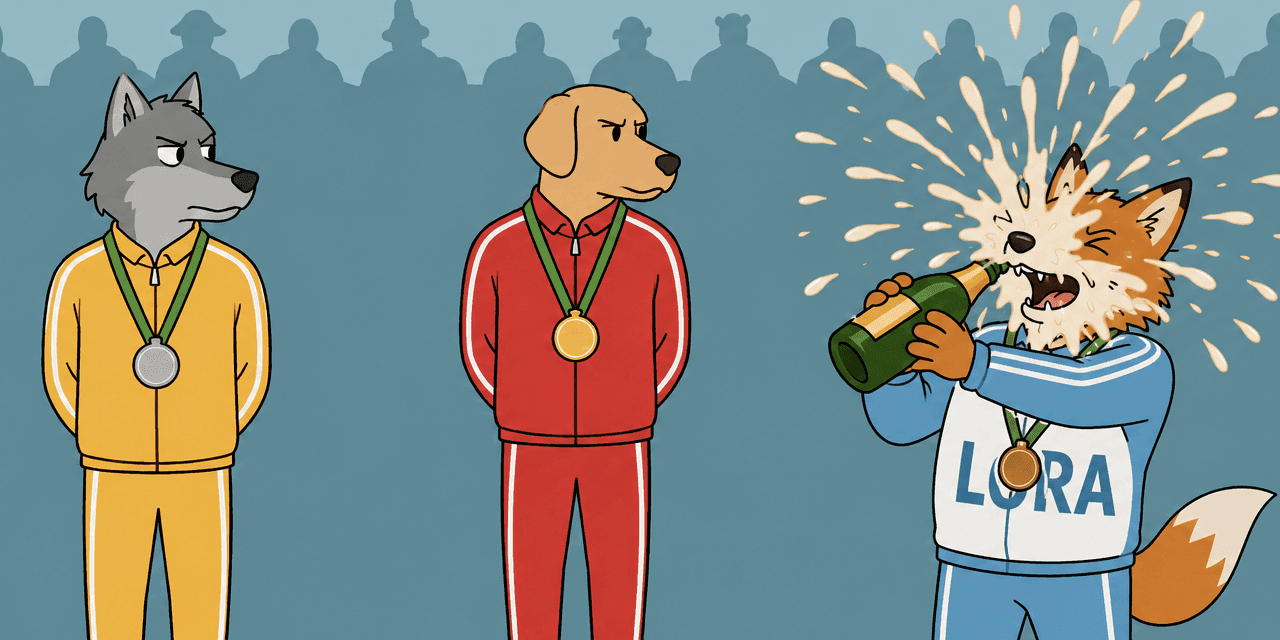
Beyond LoRA: Can You Beat the Most Popular Fine-Tuning Technique?
Fine-tuning large language models (LLMs) has become a cornerstone for adapting these powerful AI systems to specific tasks and domains. Instead of training an entire model from scratch, which demands immense computational resources and time, fine-tuning allows practitioners to leverage pre-trained models and adjust them for niche applications. This process significantly reduces costs and accelerates deployment. Among the various fine-tuning methods, Low-Rank Adaptation, or LoRA, has emerged as a dominant technique, widely adopted for its efficiency and effectiveness. However, as the field of AI evolves rapidly, researchers are constantly pushing the boundaries of what's possible. The question "Beyond LoRA: Can you beat the most popular fine-tuning technique?" is becoming increasingly relevant. While LoRA offers substantial benefits, it also has limitations. This article will dive deep into LoRA's mechanics, explore its constraints, and then introduce several cutting-edge alternatives that aim to offer superior performance, efficiency, or specialized capabilities. We'll examine how these techniques work, their unique advantages, and what they mean for AI practitioners and developers.Understanding LoRA: The Current Champion
LoRA, introduced by Microsoft researchers, is a Parameter-Efficient Fine-Tuning (PEFT) technique designed to accelerate the fine-tuning of large models while using less memory. The core idea behind LoRA is to freeze the pre-trained weights of an LLM and inject small, trainable low-rank matrices (called "adapters") into specific layers, typically the attention blocks of Transformer models. Instead of updating the entire weight matrix (W), LoRA approximates the update by representing it as the product of two much smaller matrices, A and B (∆W = BA). During fine-tuning, only the parameters in these small A and B matrices are updated, while the original large weight matrix W remains frozen.Why LoRA is Popular:
- Reduced Trainable Parameters: LoRA drastically cuts the number of parameters that need to be trained, often to less than 1% of the original model's total parameters.
- Memory Efficiency: By training fewer parameters, LoRA significantly lowers the GPU memory requirements compared to full fine-tuning. This makes it possible to fine-tune large models on more accessible hardware.
- Faster Training: Fewer trainable parameters generally lead to faster training cycles.
- No Inference Latency: After training, the LoRA adapter weights (BA) can be merged back into the original frozen weights (W + BA), resulting in a model with the same architecture and no additional inference overhead.
- Portability: The small LoRA adapters can be easily swapped out for different tasks, allowing a single base model to serve multiple specialized applications.
Limitations of LoRA:
While powerful, LoRA isn't perfect. Its low-rank approximation can sometimes limit the model's "adaptation capacity," meaning it might not achieve the same peak performance as full fine-tuning on highly complex or divergent tasks.- Scope of Adaptation: LoRA is best suited for relatively narrow fine-tuning, such as adapting to a specific style or product. It may struggle with tasks requiring substantial changes to the model's fundamental understanding or capabilities.
- Limited by Base Model Capacity: LoRA relies on the base model's existing architecture. If the base model lacks understanding in a particular domain, LoRA cannot fully compensate.
- Performance with Large Batch Sizes: LoRA's performance can degrade faster than full fine-tuning when using very large batch sizes.
- Instruction Following Limitations: Some research suggests LoRA fine-tuning might be limited to learning response initiation and style tokens, rather than enhancing core knowledge or skills, especially in instruction tuning.
Beyond LoRA: Exploring Advanced Fine-Tuning Techniques
The quest for more efficient and effective fine-tuning methods has led to several innovative approaches. These techniques often build upon LoRA's principles or introduce entirely new mechanisms to achieve better results.1. QLoRA: Quantized LoRA for Extreme Memory Savings
QLoRA, or Quantized LoRA, is arguably the most direct and widely adopted extension of LoRA. Developed by Tim Dettmers et al., QLoRA addresses one of the biggest challenges in fine-tuning: memory consumption.How it Works:
QLoRA works by loading the base large language model in a highly compressed 4-bit quantized format. This drastically reduces the memory footprint of the base model itself. During fine-tuning, only the small LoRA adapters are trained in a higher precision (e.g., 16-bit), while the 4-bit quantized base model weights remain frozen. QLoRA also uses techniques like 4-bit NormalFloat (NF4) quantization and paged optimizers to manage memory efficiently.Key Advantages:
- Drastic Memory Reduction: QLoRA can reduce memory usage by approximately 4x compared to standard LoRA, making it possible to fine-tune massive models (e.g., 65B parameters) on a single GPU with 48GB VRAM, or a 7B model on consumer GPUs with 16GB VRAM.
- Accessibility: This memory efficiency democratizes LLM fine-tuning, allowing more practitioners to work with large models on more affordable hardware.
- Maintains Performance: Despite aggressive quantization, QLoRA often maintains competitive performance, achieving near full fine-tuning quality with minimal loss.
Official Repository/Links: QLoRA was introduced in the paper "QLoRA: Efficient Finetuning of Quantized LLMs" by Dettmers et al. The Hugging Face PEFT library provides robust support for QLoRA.
2. DoRA: Weight-Decomposed Low-Rank Adaptation
DoRA, or Weight-Decomposed Low-Rank Adaptation, is a fine-tuning method developed by NVIDIA Research Taiwan and the NVIDIA Learning and Perception Research Group. Introduced in February 2024 by Liu et al., DoRA aims to bridge the accuracy gap between LoRA and full fine-tuning.How it Works:
DoRA's key insight is to decompose the pre-trained weight matrix into two components: magnitude and direction. It then fine-tunes both of these components. Specifically, DoRA applies LoRA to the directional component, which is typically larger in terms of parameters, while directly fine-tuning the magnitude component. This decoupled optimization allows DoRA to achieve learning patterns closer to full fine-tuning.Key Advantages:
- Improved Performance: DoRA consistently outperforms LoRA across various tasks and model architectures, including LLMs, vision language models, and text-to-image generation. It shows better learning capacity, performing closer to full fine-tuning.
- No Extra Inference Overhead: Similar to LoRA, DoRA's decomposed magnitude and direction components can be merged back into the pre-trained weights after training, ensuring no additional latency during inference.
- Enhanced Stability: By separating magnitude and direction updates, DoRA makes fine-tuning easier and more stable.
Official Repository/Links: The original paper is "DoRA: Weight-Decomposed Low-Rank Adaptation" by Liu et al. Code is typically available on platforms like arXiv (e.g., arXiv:2402.09353).
3. LongLoRA: Extending Context Windows Efficiently
Large language models are often limited by their predefined context window sizes, which can be a bottleneck for tasks involving long documents or conversations. LongLoRA, developed by researchers at DVLAB, is an efficient fine-tuning approach specifically designed to extend the context sizes of pre-trained LLMs with limited computational cost.How it Works:
LongLoRA combines an improved LoRA method with a novel technique called Shifted Sparse Attention (S2-Attn). S2-Attn approximates standard full attention during training by splitting the context length into groups and performing attention within each group individually, with a shifting mechanism to ensure information flow between neighboring groups. This allows for efficient context extension without the computational burden of full attention on very long sequences. The LoRA component in LongLoRA is also enhanced to work well when embedding and normalization layers are trainable.Key Advantages:
- Long Context Fine-Tuning: LongLoRA can extend context windows significantly, for example, fine-tuning Llama2 7B from 4k context to 100k, or Llama2 70B to 32k, on a single 8x A100 machine.
- Computational Efficiency: It offers substantial computational savings compared to full fine-tuning for long contexts, often reducing training costs by 10x.
- Performance Comparable to Full Fine-Tuning: Models fine-tuned with LongLoRA achieve performance comparable to full-attention and fully fine-tuned models on perplexity benchmarks.
Official Repository/Links: The project's code, models, and dataset (LongAlpaca) are available on GitHub: dvlab-research/LongLoRA.
4. IA3: Infused Adapter by Inhibiting and Amplifying Inner Activations
IA3 (Infused Adapter by Inhibiting and Amplifying Inner Activations) is another parameter-efficient fine-tuning technique that takes a different approach to modifying model behavior. It was introduced by researchers at Google.How it Works:
Instead of adding low-rank matrices, IA3 optimizes the fine-tuning process by rescaling the inner activations of a pre-trained model using learned vectors. These learned vectors are incorporated into the attention and feedforward modules within a standard Transformer-based architecture. The crucial aspect is that only these learned vectors are trainable during fine-tuning, while the original pre-trained weights remain frozen.Key Advantages:
- Extreme Parameter Efficiency: IA3 can achieve even fewer trainable parameters than LoRA, sometimes as low as 0.01% of total parameters (e.g., for T0 models), compared to LoRA's >0.1%.
- Comparable Performance: Models fine-tuned using IA3 can achieve performance comparable to fully fine-tuned models.
- No Inference Latency: Similar to LoRA, the adapter weights (learned vectors) can be merged with the base model, avoiding any additional inference latency.
Official Repository/Links: IA3 is supported by the Hugging Face PEFT library.
5. AdaLoRA: Adaptive Budget Allocation
AdaLoRA (Adaptive Low-Rank Adaptation) is an enhancement of LoRA that introduces adaptive budget allocation for fine-tuning. It addresses the limitation of standard PEFT methods that often evenly distribute update budgets across all weight matrices, overlooking their varying importance.How it Works:
AdaLoRA dynamically allocates the parameter budget among weight matrices based on their importance score. It parameterizes the incremental updates using singular value decomposition (SVD), which allows it to adjust the rank of incremental matrices. Critical incremental matrices are assigned a higher rank to capture more fine-grained information, while less important ones are pruned to a lower rank to prevent overfitting and save computational budget.Key Advantages:
- Optimized Resource Allocation: By dynamically reallocating computational budgets, AdaLoRA ensures that critical layers receive more fine-tuning resources, leading to more efficient and effective fine-tuning.
- Improved Performance, Especially in Low-Budget Settings: AdaLoRA consistently outperforms baselines, particularly when the budget for trainable parameters is very low (e.g., less than 0.1% of full fine-tuning parameters).
- Enhanced Efficiency: It achieves performance comparable to full fine-tuning while drastically reducing trainable parameters, especially significant as AI models scale.
Official Repository/Links: The original paper is "AdaLoRA: Adaptive Budget Allocation for Parameter-Efficient Fine-Tuning" by Zhang et al. Code is available on GitHub: QingruZhang/AdaLoRA.
6. GaLore: Full Fine-tuning on Consumer Hardware
GaLore (Gradient Low-Rank Projection) is a memory-efficient training strategy that allows for full-parameter learning (or near full-parameter learning) with significantly reduced memory footprint, making it possible to fine-tune large models on consumer-grade GPUs.How it Works:
Unlike LoRA, which introduces new low-rank adapters, GaLore focuses on optimizing how gradients are computed and stored. It leverages the observation that gradient matrices often have a low-rank structure. GaLore projects these high-dimensional gradients onto a low-rank subspace, significantly reducing the memory required for optimizer states. It can also implement per-layer weight updates during backpropagation to further reduce memory.Key Advantages:
- Full-Parameter Learning with Reduced Memory: GaLore allows for training nearly all model parameters while achieving up to 65.5% memory savings in optimizer states compared to traditional methods. This means it can achieve performance comparable to full fine-tuning.
- Accessibility: It enables fine-tuning 7B models on consumer GPUs with 24GB VRAM (like an RTX 4090).
- Broad Compatibility: GaLore is independent of the choice of optimizers and can be easily integrated into existing ones (e.g., AdamW, 8-bit Adam) with minimal code changes.
- Outperforms LoRA in Some Cases: Benchmarks show GaLore can outperform LoRA on tasks like GLUE.
Official Repository/Links: The original paper is "GaLore: Memory-Efficient LLM Training by Gradient Low-Rank Projection" by Lin et al. It is implemented as an optimizer in Hugging Face Transformers.
Other Noteworthy PEFT Techniques:
- Prefix Tuning: Adds trainable "prefixes" (virtual tokens) to input sequences, leaving model weights completely frozen. It's very storage-efficient and good for simple, focused tasks.
- Prompt Tuning: Similar to prefix tuning, it uses soft prompts (learnable embeddings) that are optimized for a specific task without modifying model parameters.
- Adapter Tuning: Involves inserting small bottleneck neural networks (adapters) between existing layers. Only these adapter weights are trained. Adapters can add some inference latency as they are separate modules.
- VeRA (Vector-based Random Adaptation) and FourierFT: These are additive PEFT methods that have shown promising results, sometimes outperforming LoRA in terms of parameter efficiency and domain adaptation, particularly in specialized tasks like time series forecasting. VeRA, for instance, claims 10x fewer parameters with shared random matrices.
What This Means for AI Practitioners
The landscape of fine-tuning is constantly evolving, and relying solely on LoRA might mean missing out on significant improvements in specific use cases. For AI practitioners, understanding these alternatives is crucial for several reasons:- Resource Optimization: Techniques like QLoRA and GaLore make fine-tuning large models accessible even with limited GPU resources, opening doors for individual developers and smaller teams.
- Performance Gains: DoRA and AdaLoRA demonstrate that it's possible to achieve performance closer to full fine-tuning, or even surpass LoRA, by intelligently managing parameter updates.
- Specialized Applications: LongLoRA is a game-changer for applications requiring extended context windows, while IA3 offers extreme parameter efficiency for certain models.
- Flexibility and Experimentation: The Hugging Face PEFT library provides a unified API for many of these techniques, making it easier to experiment and find the best method for your specific task and dataset.
Frequently Asked Questions
What is Parameter-Efficient Fine-Tuning (PEFT)?
Parameter-Efficient Fine-Tuning (PEFT) refers to a collection of techniques that significantly reduce the memory and computational requirements for fine-tuning large pre-trained models. Instead of updating all billions of parameters, PEFT methods modify or introduce only a small subset of parameters, making the process faster and more accessible.
Why should I consider alternatives to LoRA?
While LoRA is highly efficient, alternatives can offer specific advantages. QLoRA provides even greater memory savings through quantization, DoRA can achieve better performance closer to full fine-tuning, LongLoRA specializes in extending context windows, and techniques like IA3 or GaLore offer different trade-offs in parameter efficiency and learning capacity. Choosing an alternative can optimize for specific hardware constraints, performance targets, or task requirements.
Do these alternative methods add inference latency?
Many of the advanced PEFT methods, including LoRA, QLoRA, DoRA, and IA3, are designed so that their small, trained components can be merged back into the base model's weights after fine-tuning. This means they typically do not introduce any additional inference latency compared to the original base model. However, some methods like Adapter Tuning might introduce a slight overhead if their modules cannot be fully merged.
Which fine-tuning technique is best for my specific use case?
The "best" technique depends heavily on your specific needs. If memory is your primary concern, QLoRA is an excellent choice. If you need to extend the context window of an LLM, LongLoRA is tailored for that. For maximizing performance while maintaining efficiency, DoRA might be superior. For extreme parameter efficiency, IA3 could be suitable. It's often recommended to experiment with a few promising PEFT methods using the Hugging Face PEFT library to find the optimal balance of performance and resource usage for your particular task and dataset.