Key Takeaways
- Hugging Face, LeRobot, and Strands Agents combine to create a unified, open-source workflow for deploying AI models to physical robot hardware.
- LeRobot, developed by Hugging Face and Google DeepMind, provides a comprehensive, PyTorch-based library for robot learning, offering standardized datasets, policies, and hardware interfaces.
- Strands Agents, an open-source SDK from AWS, enables natural language control of robots by orchestrating AI models (including those from Hugging Face) and tools within an agentic loop.
- This integration streamlines the "sim-to-real" gap, allowing developers to record demonstrations, train policies in simulation, and deploy to physical robots with minimal code changes.
The world of robotics is rapidly evolving, driven by breakthroughs in Artificial Intelligence. However, bridging the gap between sophisticated AI models developed in research labs and their practical deployment on physical robot hardware has historically been a complex and fragmented challenge. Developers often grapple with incompatible tools, diverse data formats, and the intricate dance of transferring learned behaviors from simulation to the real world. This is where the synergy of the Hugging Face Hub, LeRobot, and Strands Agents offers a powerful, unified solution for developers.
This article will explain how these three platforms work together to create a streamlined, open-source pipeline, simplifying the development and deployment of intelligent robotic systems. We'll explore what each component brings to the table and how their integration makes advanced robot learning more accessible than ever before for AI practitioners and roboticists.
The AI-Robotics Gap: A Persistent Challenge
For years, the journey from an AI model's inception to its operation on a physical robot has been fraught with hurdles. Researchers might train a cutting-edge perception model using vast datasets, but then face significant engineering challenges in integrating that model with a robot's control system, sensors, and actuators. This often involves custom code for data handling, communication protocols, and real-time inference, making the process time-consuming and difficult to reproduce. Moreover, the transition from simulated environments (where most AI models are trained) to the complexities of the real world—known as the "sim-to-real" gap—adds another layer of difficulty.
Traditional robotics pipelines tend to be modular and rely on hand-crafted features, while modern robot learning uses monolithic, data-driven policies. The lack of standardized tools and formats has slowed down progress, creating a demand for integrated solutions that can unify the entire robot learning stack.
Hugging Face Hub: The AI Model Powerhouse
The Hugging Face Hub has become an indispensable platform for the AI community, often described as the "GitHub for AI." It's a central, web-based platform where users can share, discover, and collaborate on machine learning models, datasets, and applications. Launched in 2020, the Hub hosts hundreds of thousands of pre-trained models for various tasks, including natural language processing, computer vision, and speech recognition.
Key aspects of the Hugging Face Hub include:
- Vast Model Repository: Over 300,000+ pre-trained models are available for immediate use, covering diverse AI domains.
- Standardized Libraries: Core libraries like Transformers and Datasets provide a unified API, simplifying the process of loading, using, and sharing models and data.
- Hugging Face Spaces: A service for hosting and sharing live, interactive demos of machine learning models, making it easy to showcase work.
- Open-Source Ethos: The Hub fosters a vibrant open-source community, enabling easy access, contribution, and collaboration.
For developers, the Hub significantly simplifies workflows by providing ready-to-use models and datasets, reducing the need to train models from scratch. It also supports private repositories for teams and enterprises, ensuring secure collaboration.
Hugging Face Pricing
The Hugging Face Hub itself is free to use, offering unlimited access to thousands of public models and datasets. However, for advanced features and production-grade deployments, Hugging Face offers several plans:
- Free Tier: Includes access to over 2 million public models and datasets, 100 GB of private repository storage, community Spaces, and a standard ZeroGPU quota.
- PRO Plan ($9/month): Upgrades ZeroGPU quota, increases private storage to 1 TB, provides additional Inference Provider credits, and unlocks Spaces Dev Mode with SSH and VS Code access.
- Team Plan ($20/user/month): Designed for organizations, offering PRO perks for all members, increased public and private storage, pooled Inference Provider credits, and priority support.
- Enterprise Plan (starting at $50/user/month): Provides advanced governance features like SSO, SCIM for automated user provisioning, and custom SLAs for large contracts.
Costs for running models on Spaces, Inference Endpoints, or Inference Providers are separate and based on pay-as-you-go compute charges.
Introducing LeRobot: Bridging the Gap for Robot Learning
LeRobot is an open-source library developed by Hugging Face, with significant contributions from Google DeepMind, that aims to make AI for robotics more accessible through end-to-end learning. It's a comprehensive, PyTorch-based toolkit designed to integrate across the entire robot learning stack.
LeRobot addresses the fragmentation in robotics development by providing a unified ecosystem for:
- Standardized Datasets: It introduces the LeRobotDataset format, an efficient, multimodal format for recording, storing, and streaming high-frame-rate sensory and image data. These datasets can be easily hosted and explored on the Hugging Face Hub, fostering openness and research reproducibility.
- State-of-the-Art Policies: LeRobot includes clean, PyTorch-based implementations of various state-of-the-art robot learning methods, including imitation learning and reinforcement learning, optimized for training custom models and using pre-trained ones.
- Unified Robot Integration: It offers a consistent, Python-based middleware API for real-world motor control across diverse robot platforms. This hardware-agnostic interface decouples control logic from hardware specifics, supporting robots like SO-100/SO-101 arms, ALOHA-2 manipulators, and mobile platforms like LeKiwi.
- Optimized Inference: LeRobot features an optimized inference stack that separates action planning from control execution, allowing policies to run on separate, more powerful machines and in parallel with low-level control loops for robust, dynamic deployment.
- Simulation Environments: It comes with Gymnasium environments for simulations, allowing developers to get started without physical hardware.
The goal of LeRobot is to lower the barrier to entry for robotics, allowing more developers to contribute and benefit from shared datasets and pre-trained models. It aims to be a "Transformers for robotics," offering a shared hub of policies, standardized datasets, and a unified API.
You can find the official LeRobot GitHub repository for more details and installation instructions.
Strands Agents: Orchestrating Robot Behavior
Strands Agents is an open-source SDK, initially released by AWS, designed for building autonomous AI agents with a "model-first" approach. It provides a flexible, extensible framework that leverages the reasoning abilities of modern large language models (LLMs) to handle planning and tool usage autonomously.
Key features of Strands Agents include:
- Model-First Design: The foundation model is at the core of agent intelligence, enabling sophisticated autonomous reasoning rather than rigid, pre-scripted paths.
- Agent Loop: A lightweight and flexible agent loop drives interactions, where the LLM iteratively reads context, plans actions, calls tools, and incorporates results to decide the next step.
- Tool Use and Integration: Agents can call external functions or APIs as "tools," including pre-built examples for arithmetic, web requests, and more. It also supports the Model Context Protocol (MCP) for accessing thousands of external tools.
- Multi-Agent Collaboration: Built-in coordination models like Swarm, Graph, and Workflow patterns enable scalable collaboration across distributed agent networks.
- Model Agnostic: Strands Agents is not tied to a single LLM provider and supports various foundation models, including those on Amazon Bedrock, Anthropic Claude, Meta Llama, and OpenAI, through flexible API integration.
- Production Readiness: It includes built-in observability via OpenTelemetry, metrics, logs, and distributed tracing, along with reference architectures for AWS Lambda, AWS Fargate, and Amazon EC2.
Strands Agents simplifies agent development by letting developers define an agent with a natural language prompt and a list of tools, allowing the LLM to figure out how to chain its reasoning and invoke tools as needed.
The Strands Agents SDK is open source and licensed under Apache License 2.0. While Strands Agents itself is free and open-source, costs are incurred for model inference (token usage from providers) and infrastructure (AWS compute and storage).
The Synergy: From Hugging Face to Robot Hardware
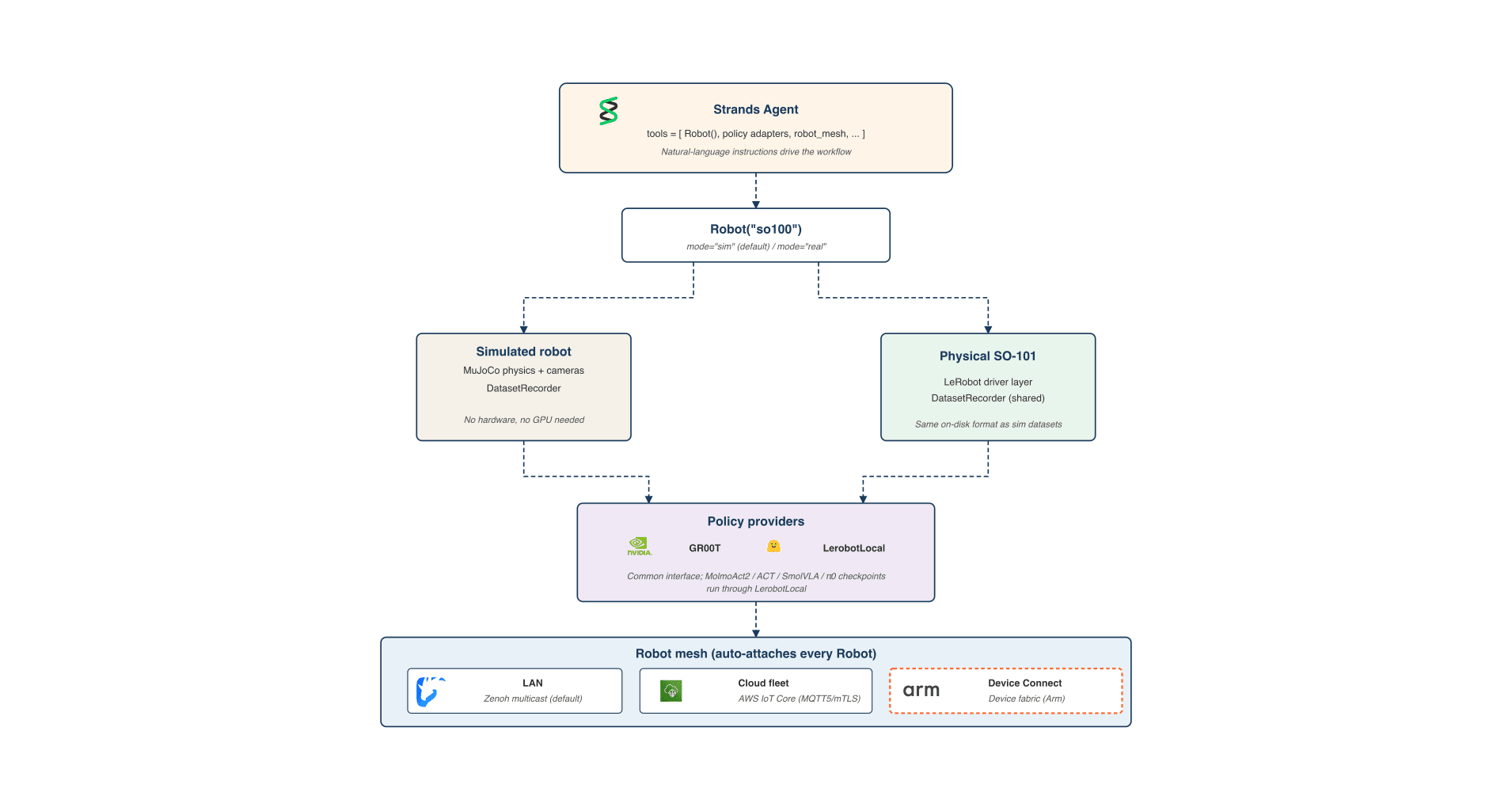
The true power emerges when Hugging Face Hub, LeRobot, and Strands Agents are brought together. This integration creates a seamless pipeline for developing, training, and deploying AI models directly onto physical robots. Strands Robots, an open-source SDK from AWS, unifies robotic AI development by integrating the Hugging Face Hub and LeRobot stack into a single, agent-driven workflow.
Here's how they fit together:
- Data Collection and Standardization: LeRobot provides the tools and a unified LeRobotDataset format for collecting high-quality, multimodal data from real robots or simulations. This data can then be pushed directly to the Hugging Face Hub, making it accessible for training and sharing.
- Model Training and Sharing: Developers can use LeRobot's state-of-the-art policies (like ACT or Diffusion Policy) to train models on datasets from the Hugging Face Hub. These trained policies can then also be stored and shared on the Hub.
- Agent Orchestration for Robotics: Strands Agents acts as the orchestrator. It can consume AI models (e.g., vision-language-action (VLA) models like NVIDIA GR00T) from the Hugging Face Hub and use them as "tools" within its agentic loop.
- Unified Control and Deployment: Strands Robots exposes LeRobot's abstractions and simulation capabilities as AgentTools. This allows a single Strands agent to manage the entire workflow: from recording demonstrations in simulation (which use the same LeRobotDataset format as real hardware), to running policies in simulation, and finally deploying the same agent code to physical hardware with minimal configuration changes.
- Sim-to-Real Bridge: The integration ensures that simulation-captured data and hardware-recorded demonstrations share identical storage schemas, enabling training scripts to process either data source without modification. This significantly lowers the barrier for transferring models from simulation to real-world robots.
- Natural Language Control: Strands Agents enables natural language control of physical robots. An agent equipped with Strands AgentTools can interpret instructions like "pick up the red block" and translate them into coordinated motor actions by interacting with the underlying LeRobot stack and deployed AI policies.
This integrated approach allows for a "one agent loop" workflow, where a developer can record a demonstration, run a policy in simulation, and then deploy that same policy to a physical robot, even coordinating multiple robots across a fleet using a Zenoh-based peer mesh.
For developers interested in getting hands-on, the strands-labs/robots repository provides runnable examples, including a companion application for the Hub-to-hardware workflow that can be run in simulation without needing physical hardware or Hugging Face credentials for default paths.
Real-World Implications and Future
This powerful integration has significant implications for the future of AI and robotics:
- Accelerated Development: Roboticists and AI developers can prototype, test, and deploy AI-driven robotic behaviors much faster, reducing the development cycle from weeks to days or even hours.
- Democratization of Robotics: By standardizing data formats, providing open-source tools, and leveraging community-driven model sharing, the barrier to entry for robot learning is significantly lowered. This allows more researchers, startups, and individual developers to contribute to and benefit from advancements in robotics.
- Enhanced Reproducibility: Standardized datasets and shared models on the Hugging Face Hub, combined with LeRobot's framework, make research more reproducible and verifiable.
- Scalable Deployments: Strands Agents' capabilities for multi-agent collaboration and production-ready deployments mean that sophisticated AI behaviors can be scaled from single robots to entire fleets, enabling more complex autonomous systems.
- Faster Sim-to-Real Transfer: The consistent data format and unified workflow greatly simplify the process of transferring models trained in simulation to real-world hardware, a critical bottleneck in robotics.
The collaboration between Hugging Face and AWS (through Strands Agents) is aligning cloud-scale AI orchestration with edge-deployed robotic systems, paving the way for more intelligent and autonomous physical AI.
Conclusion
The integration of the Hugging Face Hub, LeRobot, and Strands Agents represents a significant leap forward in making AI for robotics more accessible and efficient. By providing a unified, open-source stack that handles everything from data collection and model training to agent orchestration and hardware deployment, these platforms are empowering developers to build sophisticated robotic systems with unprecedented ease. This synergy is not just about connecting tools; it's about fostering a collaborative ecosystem that accelerates innovation and brings us closer to a future where intelligent robots are a seamless part of our world.
Frequently Asked Questions
What is LeRobot and who developed it?
LeRobot is an open-source library for robot learning developed by Hugging Face, with significant contributions from Google DeepMind. It's a PyTorch-based toolkit designed to simplify and standardize the entire robot learning stack, from data collection and model training to robot control and simulation.
What problem do Strands Agents solve in robotics?
Strands Agents, an open-source SDK from AWS, solves the problem of fragmented robotic AI development by providing a "model-first" approach to building autonomous agents. It uses large language models (LLMs) to orchestrate robot behavior through natural language commands, integrating AI models and tools (like LeRobot) into a cohesive agent loop.
How do Hugging Face, LeRobot, and Strands Agents work together?
The Hugging Face Hub acts as a central repository for sharing LeRobot's standardized datasets and trained AI models. LeRobot provides the framework for collecting data, training robot policies, and interfacing with hardware. Strands Agents then orchestrates these components, allowing an AI agent to consume models from the Hub and use LeRobot's capabilities to control physical robots or simulations based on natural language instructions, streamlining the entire development and deployment workflow.
Is this solution suitable for real-world robot deployment?
Yes, this integrated solution is designed with real-world robotics in mind. LeRobot provides optimized inference for robust deployment and supports various physical robot platforms. Strands Agents also offers production-ready features like observability, multi-agent collaboration, and scalable deployment options, making it suitable for deploying intelligent AI agents on physical hardware.