Key Takeaways
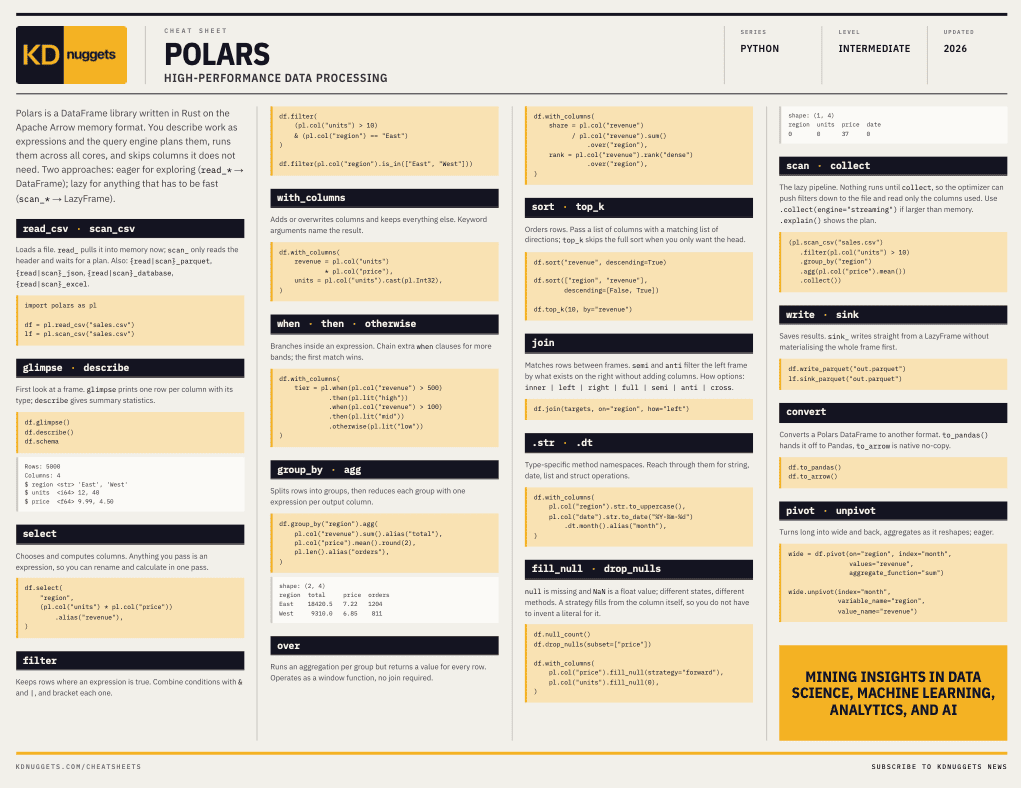
- Polars is a high-performance DataFrame library built in Rust, leveraging the Apache Arrow memory format for incredibly fast data processing.
- It uses a unique "expression model" and a query engine with lazy evaluation, optimizing data operations before execution for speed and memory efficiency.
- Polars is open-source and free to use, offering significant performance advantages over Pandas for large datasets and complex data engineering tasks.
- It provides multi-language bindings for Python, Rust, Node.js, and R, making it accessible to a broad range of developers.
Understanding Polars: The Next-Gen DataFrame Library for High-Performance Data Processing
In the world of data, speed and efficiency are everything. As datasets grow larger and more complex, traditional tools often struggle to keep up, leading to slow processing times and high memory usage. This is where Polars steps in, offering a powerful, high-performance DataFrame library designed to tackle these challenges head-on. Built in Rust and leveraging the Apache Arrow memory format, Polars is quickly becoming a go-to solution for developers and data practitioners who demand speed and efficiency from their data workflows.
What Exactly is Polars?
Polars is an open-source DataFrame library specifically engineered for rapid data manipulation and analysis. While it shares conceptual similarities with other DataFrame libraries like Python's Pandas, Polars stands out due to its underlying architecture and design philosophy.
The core of Polars is written in Rust, a systems programming language known for its performance, memory safety, and concurrency. This foundation allows Polars to bypass the Python Global Interpreter Lock (GIL), enabling true parallel processing across multiple CPU cores without additional configuration. This means that when you run a Polars computation, Python hands the logical plan to Rust, which then efficiently spawns threads across all available physical cores on your machine.
Another critical component of Polars' architecture is its use of the Apache Arrow columnar memory format. Arrow is a language-agnostic, in-memory format optimized for analytical operations on modern hardware. This columnar, contiguous memory layout allows CPUs to load thousands of values into the L1 cache simultaneously and execute Single Instruction, Multiple Data (SIMD) vectorized instructions, processing data in large blocks rather than one-by-one.
Polars was initially a "pet project" by Ritchie Vink, who started the open-source project in 2020, motivated by the limitations of existing data tools like Pandas. Ritchie Vink and Chiel Peters later co-founded Polars Inc. in 2023 to further develop the ecosystem, securing significant funding rounds.
Why Polars Matters for Developers and AI Practitioners
For anyone working with data – especially software developers, data scientists, and AI/ML engineers – Polars offers compelling advantages:
- Unmatched Performance: Polars is consistently faster and more resource-efficient than Pandas for many operations, particularly with medium to large datasets. Benchmarks show Polars outperforming Pandas by 2x to 11x for common tasks like reading data, filtering, and numerical expressions, with some TPC-H benchmarks showing even higher gains, sometimes exceeding 30x.
- Memory Efficiency: By leveraging Rust's memory model and Arrow's columnar format, Polars uses memory more efficiently, crucial when dealing with data that might not fit entirely in RAM.
- Scalability for Large Datasets: Polars' streaming API and out-of-core processing capabilities allow it to handle datasets much larger than your machine's physical memory. It breaks data into micro-batches, processing them efficiently without causing out-of-memory errors, making it possible to process terabytes of data on a single machine.
- Parallel Execution: Polars is designed from the ground up for parallelization, utilizing all available CPU cores without complex setup, which is a significant advantage over single-threaded libraries.
- Foundation for AI/ML Workflows: In AI and machine learning, data preparation, feature engineering, and large-scale data loading are often bottlenecks. Polars' speed and efficiency can drastically reduce the time spent on these steps, accelerating the entire AI development lifecycle. It integrates well with other Python libraries like NumPy and PyArrow for seamless data transitions.
How Polars Works: The Expression Model and Query Engine
The core of Polars' efficiency comes from its unique approach to data processing: describing your work as expressions and letting its query engine plan them out.
In most traditional DataFrame libraries, operations are executed "eagerly." This means each line of code runs immediately, materializing intermediate results. While straightforward for small datasets, this can be highly inefficient for complex pipelines, leading to unnecessary computations and memory allocations.
Polars introduces "lazy evaluation" (or "lazy execution"). When you write a Polars query using its expressive API, the operations are not executed right away. Instead, Polars builds a logical query plan, an Abstract Syntax Tree (AST) representation of your desired logic.
This logical plan is then optimized by Polars' query engine. Similar to how a sophisticated SQL database optimizer works, Polars can inspect the entire sequence of operations and apply various optimizations before any data processing begins. These optimizations include:
- Predicate Pushdown (Filter Pushdown): Filters are applied as early as possible in the execution plan, often directly at the data source (e.g., when reading a CSV or Parquet file). This means Polars only loads the data that actually satisfies your conditions, significantly reducing I/O and memory usage.
- Projection Pruning: Only the columns needed for the final result are read and processed, discarding unnecessary columns early on.
- Expression Optimization: Polars can rearrange and combine operations for maximum efficiency, minimizing redundant work and memory allocations.
- Parallelization: The optimized plan is then executed in parallel across all available CPU cores.
This lazy approach, combined with the Rust backend and Apache Arrow memory format, allows Polars to achieve its remarkable speed and memory efficiency. You explicitly trigger the execution and collection of results using methods like `.collect()`.
Key Features of Polars
Polars offers a rich set of features that make it a powerful tool for data manipulation:
- Lazy and Eager Execution: You can choose between eager execution for interactive work (similar to Pandas) or lazy execution for optimized pipelines.
- Expressive API: Polars provides an intuitive and concise API for data manipulation tasks like filtering, sorting, grouping, joining, and aggregating. Its expression system allows you to build complex data pipelines with readable code.
- Multi-threaded and Vectorized: Built-in parallelism and SIMD vectorized execution ensure that Polars fully utilizes modern hardware for maximum performance.
- Out-of-Core Processing (Streaming): Polars can process datasets larger than your available RAM by streaming data in chunks, making it suitable for big data workloads on a single machine.
- Apache Arrow Integration: Seamless integration with Apache Arrow enables zero-copy data sharing with other Arrow-compatible systems, reducing serialization overhead.
- Broad I/O Support: Polars supports reading and writing to various common data formats, including CSV, Parquet, JSON, Avro, Feather/IPC, Delta Lake, and more, as well as cloud storage and databases.
- Multi-language Bindings: While its core is Rust, Polars provides official bindings for Python, Rust, Node.js, and R, making it accessible to a wider developer community.
- GPU Support: Polars optionally supports running queries on NVIDIA GPUs for even greater performance in both in-memory and streaming workloads.
- Strict Schema: Polars adheres to a strict schema, meaning data types are known before running a query, which contributes to predictable performance and helps catch inconsistencies early.
Polars vs. Pandas: A Quick Look
Pandas has long been the dominant DataFrame library in the Python ecosystem. However, as data volumes have exploded, its limitations, particularly around performance and memory usage for large datasets, have become more apparent.
While Pandas is highly flexible and has a vast ecosystem, Polars offers a modern, performance-oriented alternative. For small to medium datasets and exploratory analysis, Pandas remains a strong choice due to its familiarity and extensive library integrations. However, for data engineering tasks, ETL, analytics on large tables, or when performance and memory efficiency are critical, Polars generally provides a significant advantage. Many developers find Polars to be 3-10x faster for large ETL workloads, with some benchmarks showing even higher speedups.
The key differences lie in their execution models (eager vs. lazy) and underlying implementations (Python/C extensions vs. Rust/Apache Arrow). Polars' built-in parallelism and query optimization are fundamental to its superior performance on modern hardware.
Getting Started with Polars
Getting started with Polars is straightforward for Python developers:
You can install Polars using pip:
pip install polarsThen, you can import it and start working with DataFrames:
import polars as pl

# Create a DataFrame
data = {
    "city": ["New York", "London", "Paris", "Tokyo"],
    "population": [8_400_000, 8_900_000, 2_100_000, 13_900_000],
    "country": ["USA", "UK", "France", "Japan"]
}
df = pl.DataFrame(data)
print(df)

# Perform a lazy operation (e.g., filter and sort)
lazy_df = df.lazy().filter(pl.col("population") > 5_000_000).sort("population", descending=True)

# Collect the results
result_df = lazy_df.collect()
print(result_df)
The Polars official user guide provides comprehensive documentation and examples for various data manipulation tasks.
What Polars Means for AI Practitioners and Developers
For AI practitioners and developers, Polars represents a significant leap forward in data handling. In machine learning, the "data bottleneck" is a common problem, where the time spent loading, cleaning, and transforming data can far exceed the time spent training models. Polars' speed and memory efficiency directly address this by:
- Accelerating Data Loading: Quickly ingest large datasets from various sources (CSV, Parquet, etc.) into memory-efficient DataFrames.
- Boosting Feature Engineering: Perform complex transformations, aggregations, and joins on massive datasets much faster, creating features more rapidly for model training.
- Enabling Larger-than-RAM Workflows: Process datasets that traditionally would require distributed computing frameworks, but now can be handled on a single powerful machine using Polars' streaming capabilities. This simplifies infrastructure and reduces costs.
- Improving Iteration Speed: Faster data processing means quicker experimentation and iteration on models, leading to more efficient development cycles.
While Polars is not a replacement for distributed processing frameworks like Spark for truly massive, multi-node workloads, its ability to efficiently handle hundreds of gigabytes, even terabytes, of data on a single machine fills a crucial gap between Pandas and complex distributed systems.
For teams that need even more scale, Polars Cloud offers a managed service that extends Polars' capabilities to distributed environments, providing seamless scaling and zero infrastructure management, with a pay-as-you-go model.
Polars is more than just a fast DataFrame library; it's a paradigm shift in how developers can approach high-performance data processing, making sophisticated data operations more accessible and efficient than ever before.
Frequently Asked Questions
What is the main difference between Polars and Pandas?
The main difference lies in their architecture and execution model. Polars is built in Rust, uses the Apache Arrow columnar memory format, and features a lazy evaluation query engine, which optimizes operations before execution and leverages multi-core CPUs. Pandas is primarily Python-based with C extensions, uses an eager execution model, and is largely single-threaded for DataFrame operations. This makes Polars significantly faster and more memory-efficient for large datasets, especially in data engineering tasks.
Is Polars free to use?
Yes, Polars is an open-source project and is completely free to use under the MIT license. There are commercial offerings like Polars Cloud for managed, distributed processing, but the core library remains free.
Can Polars handle datasets larger than my computer's RAM?
Yes, Polars supports "out-of-core" processing through its streaming API. This allows it to efficiently process datasets that are too large to fit entirely into memory by breaking them down into smaller chunks and executing the optimized query plan incrementally, minimizing memory usage.
What programming languages can I use Polars with?
While the core is written in Rust, Polars provides official bindings and APIs for Python, Rust, Node.js, and R, making it a versatile tool for developers across different ecosystems.