Key Takeaways
- TypeSafe AI's Jev is a "System One Model" designed for fast, structured decision-making, not text generation.
- It addresses the "language tax" of traditional LLMs by providing typed outputs with calibrated confidence for tasks like classification and routing.
- Jev boasts significant speed and cost advantages over LLMs for decision-making, with input tokens priced at $0.042 per million and free output tokens.
- Developed by ex-OpenAI engineers, Jev utilizes a new architecture, parallel sampling, and Reinforcement Learning for Calibrated Decisions (RLCD).
The world of Artificial Intelligence moves at an incredible pace, with new tools and models emerging constantly. Among the latest to capture significant attention is Jev, from TypeSafe AI. Heralded by some as a game-changer for machine-native intelligence, Jev promises to shift how we think about AI's role in software. But with every new innovation comes a wave of hype, making it crucial to separate genuine advancements from exaggerated claims. This deep dive will unpack TypeSafe AI's Jev, exploring what it truly does, what makes it unique, and where the excitement might be getting a little ahead of itself.
What Exactly is TypeSafe AI's Jev?
At its core, TypeSafe AI's Jev is a proprietary artificial intelligence model developed by TypeSafe AI, a company founded in 2024 by ex-OpenAI engineer Diogo Almeida, along with Erik Gafni and Sasha Sheng. It was released in limited early access on September 15, 2026, and has quickly been integrated into platforms like Vercel, Cloudflare, and LangChain.
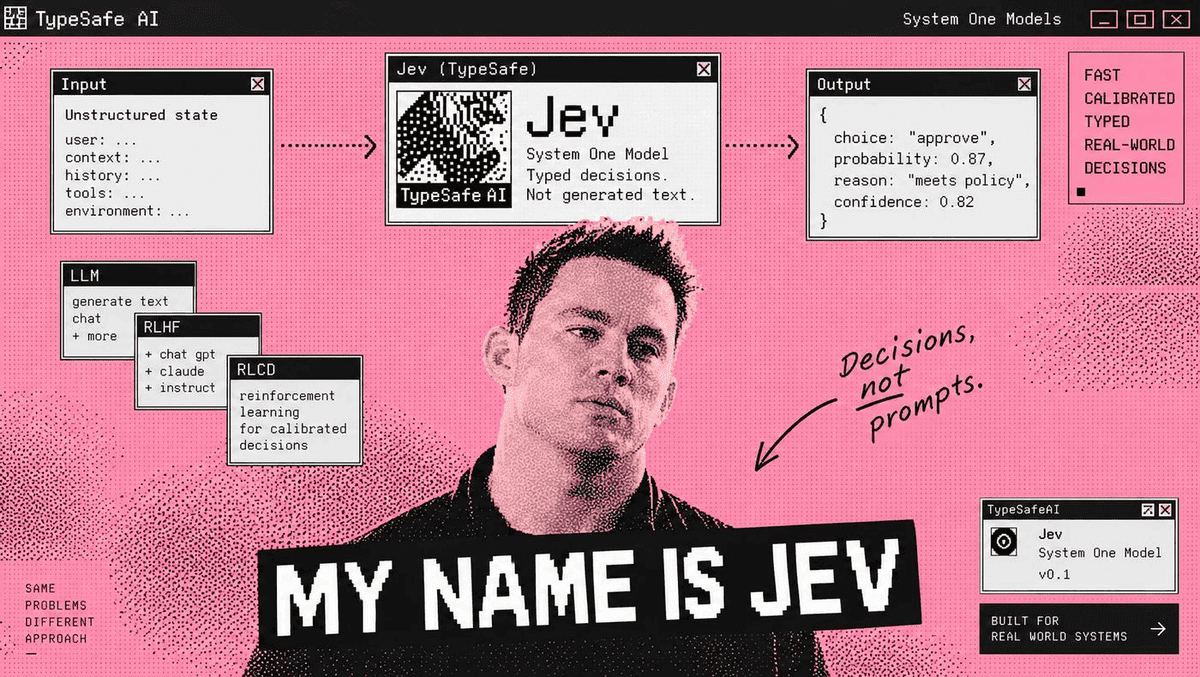
What sets Jev apart immediately is its fundamental purpose: it is explicitly not a large language model (LLM) designed for generating natural language text. Instead, TypeSafe AI refers to Jev as a "System One Model." This term borrows from Daniel Kahneman's psychological distinction between fast, intuitive thinking (System 1) and slower, deliberate reasoning (System 2). In the context of AI, Jev embodies System 1 by focusing on rapid, structured decision-making that software can consume directly.
Unlike an LLM that might produce a paragraph of text in response to a prompt, Jev returns typed values—choices, scores, or probabilities—along with a confidence factor. This direct, machine-readable output is designed for automation and integration into software workflows, where a precise, predictable answer is needed more than a conversational response.
The Problem Jev Aims to Solve: The "Language Tax" of LLMs
Traditional large language models, while incredibly powerful for tasks involving human-like communication, often introduce inefficiencies when used for structured decision-making within software. Imagine an AI agent needing to classify a customer support ticket, route a request, or validate a policy. If you use an LLM for these tasks, it will generate a text-based response that then needs to be parsed, formatted, and validated by your code. This process, often dubbed the "language tax," adds latency, cost, and a potential for errors due to the open-ended nature of text generation.
The "language tax" manifests in several ways:
- Increased Latency: Generating text, token by token, is inherently slower than directly outputting a structured value.
- Higher Cost: LLMs are typically priced per token for both input and output. Generating extraneous words for a simple decision increases costs unnecessarily.
- Parsing Complexity: Converting free-form text into a structured format for software to act upon requires additional code, which can be brittle and prone to failure if the LLM's output deviates from expectations.
- Overconfidence and Mode Dropping: Models optimized for human preference (via techniques like Reinforcement Learning from Human Feedback, or RLHF) can sometimes exhibit overconfidence or "mode dropping" (failing to consider alternative valid responses), which necessitates a human in the loop for critical decisions.
Jev aims to circumvent this "language tax" by being purpose-built for these structured decision points. Its design prioritizes speed, cost-effectiveness, and reliability for machine-to-machine interactions.
How Jev Works: Architecture, RLCD, and API Interaction
Jev operates through a straightforward API interaction. Developers send a "state" (the relevant context or data) and a set of "typed questions" to Jev. Jev then processes these questions and returns structured decisions with associated probabilities and confidence scores.
State and Typed Questions
The "state" is crucial; it's the input information Jev needs to evaluate. This could be a customer support ticket, sensor data, or any other relevant context. The "questions" are precisely defined queries that tell Jev what kind of decision to make.
Parallel Evaluation
A key architectural difference from many LLMs is Jev's ability to evaluate multiple questions in parallel and in isolation against the same state. TypeSafe AI states that adding more questions barely impacts response time, making it highly efficient for complex decision workflows involving several concurrent judgments.
Question Types (Primitives)
Jev offers three primary question types, or "primitives," to enable structured decision-making:
- Choice: This allows Jev to select one option from a predefined list of up to 255 possibilities. For example, routing a support ticket to "Billing," "Technical Support," or "Sales." The output includes the chosen option, its probability, and an overall confidence score.
- Score: With a Score question, Jev rates an input against an ordered scale or rubric. This is useful for assessing severity (e.g., "Cosmetic Issue," "Broken Feature with Workaround," "Work Blocked") or sentiment. It returns a score, along with probabilities for each level and a confidence score.
- Noul: This is a simple yes/no proposition, where Jev returns a probability between 0 and 1 indicating the likelihood of the statement being true. For instance, "Is the customer asking for a refund?"
Calibrated Confidence with RLCD
A significant innovation in Jev's underlying technology is its training method: Reinforcement Learning for Calibrated Decisions (RLCD). Unlike traditional RLHF, which optimizes models for human preference in generating text, RLCD focuses on ensuring that Jev's reported confidence scores accurately reflect the probability of a decision being correct. This means if Jev reports 80% confidence in a decision, it should be correct approximately 80% of the time across many similar scenarios. This calibration is vital for building reliable automated systems that can act autonomously when confidence is high and escalate to a human when uncertainty warrants it.
TypeSafe AI also highlights a new architecture and a parallel sampler as part of Jev's novel stack, though specific architectural details have not been fully disclosed.
What Makes Jev Genuinely New and Different?
While the concept of structured output from AI isn't entirely new, Jev brings several genuinely novel aspects to the forefront:
- Decisions, Not Strings by Design: The core philosophy of Jev is to fundamentally bypass text generation for specific tasks. It's not an LLM that's coerced into structured output; it's built for it. This design choice leads to inherent advantages in speed and cost.
- Reinforcement Learning for Calibrated Decisions (RLCD): The RLCD training paradigm is a significant differentiator. It directly addresses the "overconfidence" and reliability issues often seen in LLMs, providing a confidence score that developers can trust and use to set thresholds for automation versus human intervention.
- Parallel Question Evaluation: The ability to process multiple, independent questions against the same state concurrently with minimal impact on latency is a powerful feature for complex agentic workflows.
- Guaranteed Schema Matching: Jev ensures that its outputs adhere to the predefined schema. This means if you ask it to choose from four tools, it cannot invent a fifth, which is critical for robust software integration.
- Exceptional Speed and Cost Efficiency for Decision Tasks: TypeSafe AI claims Jev is dramatically faster and cheaper than LLMs for its intended use cases. Benchmarks suggest it can be up to 193.6x faster and 444.6x cheaper for specific decision workflows. This opens up new possibilities for AI automation that were previously too expensive or slow with traditional LLMs. For instance, Jev costs $0.042 per million input tokens, with output tokens being free. This means a large volume of small, rapid decisions becomes economically viable.
Where the Hype Needs a Reality Check
While Jev presents compelling advancements, it's important to approach some of the more enthusiastic claims with a balanced perspective:
- Vendor-Run Benchmarks: Many of the impressive speed and cost savings figures come from TypeSafe AI's own internal benchmarks and workflow evaluations. While these are valuable, TypeSafe itself notes that these gains represent the "high end of real use." Real-world performance will vary depending on specific use cases, input complexity, and integration. It's always wise for developers to test Jev with their own data and workflows.
- Developer Responsibility for Confidence: Jev provides calibrated confidence scores, which is excellent, but it doesn't absolve the developer of responsibility. Jev can still misclassify information, be susceptible to adversarial attacks, or interpret literal wording rather than the intended meaning. Developers still need to design their systems to handle lower confidence scores, potentially by routing to human review or employing fallback mechanisms.
- The "Reproducibility" Argument: Some discussions have surfaced suggesting that the idea of structured decision output can, to some extent, be replicated using existing open-source LLMs with careful prompting and post-processing. While this may be true for basic structured outputs, it often comes at the cost of Jev's inherent speed, calibrated confidence, and guaranteed schema adherence. Jev's unique value lies in its purpose-built architecture and training for these specific attributes, making it a specialized tool rather than a general-purpose LLM alternative. The ease of integration and out-of-the-box reliability for structured decisions are its strong suits.
Implications for AI Practitioners and Developers
For AI practitioners, freelancers, and developers building AI-powered applications, Jev represents a significant new tool in the toolkit, particularly for:
- Building Efficient AI Agents: AI agents often require a series of rapid decisions—which tool to use, whether to retry an action, what the next step should be. Jev's speed and cost-effectiveness make these agentic loops far more efficient and economical. Companies like Decagon, which relies heavily on AI agents for support, could see substantial margin improvements by offloading decision-making to models like Jev.
- Automating Workflows: Any workflow that relies on classification, routing, scoring, or policy checks can benefit. This includes customer support ticket triage, content moderation, fraud detection, and internal process automation. Jev can provide the rapid, reliable judgments needed to automate these steps, freeing up human resources for more complex tasks.
- Cost Savings at Scale: For applications making millions of decisions daily, the cost difference between Jev and a traditional LLM can be astronomical. The free output tokens further amplify these savings, making previously uneconomical automation tasks feasible.
- Enhanced Reliability: The calibrated confidence scores allow developers to build more robust systems. They can set clear thresholds: if Jev's confidence is above 90%, proceed automatically; if it's below, flag for human review. This provides a new level of control and trust in AI-driven automation.
Pricing and Availability
Jev is currently available via a hosted API in early access, behind a waitlist. TypeSafe AI has priced Jev at $0.042 per million input tokens, with output tokens being completely free. This pricing model strongly incentivizes its use for high-volume, decision-oriented tasks where output length is minimal but speed and accuracy are paramount.
For more details on their services and to sign up for early access, you can visit the TypeSafe AI official website.
Conclusion
TypeSafe AI's Jev is a compelling new entry in the AI landscape, offering a specialized solution for structured decision-making that complements, rather than replaces, traditional large language models. Its "System One Model" approach, coupled with the innovative RLCD training and parallel processing, genuinely pushes the boundaries of efficient and reliable AI automation. While the impressive performance metrics should be validated in real-world scenarios, Jev's potential to significantly reduce the "language tax" and enable more robust AI agents is undeniable. For developers and practitioners looking to build faster, cheaper, and more reliable automated systems, Jev is certainly a technology worth exploring.
Frequently Asked Questions
What is the core difference between TypeSafe AI's Jev and a Large Language Model (LLM)?
The core difference is their primary function: LLMs like ChatGPT generate natural language text and are optimized for human interaction. Jev, on the other hand, is a "System One Model" designed specifically for rapid, structured decision-making that software can consume directly. It returns typed outputs (choices, scores, probabilities) with confidence scores, rather than generating free-form text.
How does Jev achieve its claimed speed and cost efficiency?
Jev achieves this by avoiding token-by-token text generation. It uses a new architecture, a parallel sampler, and a training method called Reinforcement Learning for Calibrated Decisions (RLCD). This allows it to evaluate multiple questions in parallel and return structured answers quickly and efficiently, bypassing the "language tax" associated with parsing LLM outputs.
What are "System One Models" and "Reinforcement Learning for Calibrated Decisions (RLCD)"?
"System One Models" are TypeSafe AI's term for AI models built for fast, intuitive, machine-consumable decisions, contrasting with the slower, reasoning-based outputs of traditional LLMs. RLCD is Jev's unique training algorithm that ensures the model's confidence scores are accurately calibrated, meaning the reported probability of a decision being correct directly correlates with its actual accuracy over many instances.
What are some practical use cases for TypeSafe AI's Jev?
Jev is ideal for any application requiring fast, structured decisions. This includes classifying customer support tickets, routing requests in automated systems, scoring the severity of issues, performing policy checks, validating inputs, and enabling efficient decision-making within AI agents.