Key Takeaways
- IBM has released Granite Time Series PatchTST-FM-r2, a powerful zero-shot time series forecasting model with a commercial-friendly license.
- This model, with approximately 385 million parameters, excels at making predictions on new data without needing fine-tuning or task-specific fitting.
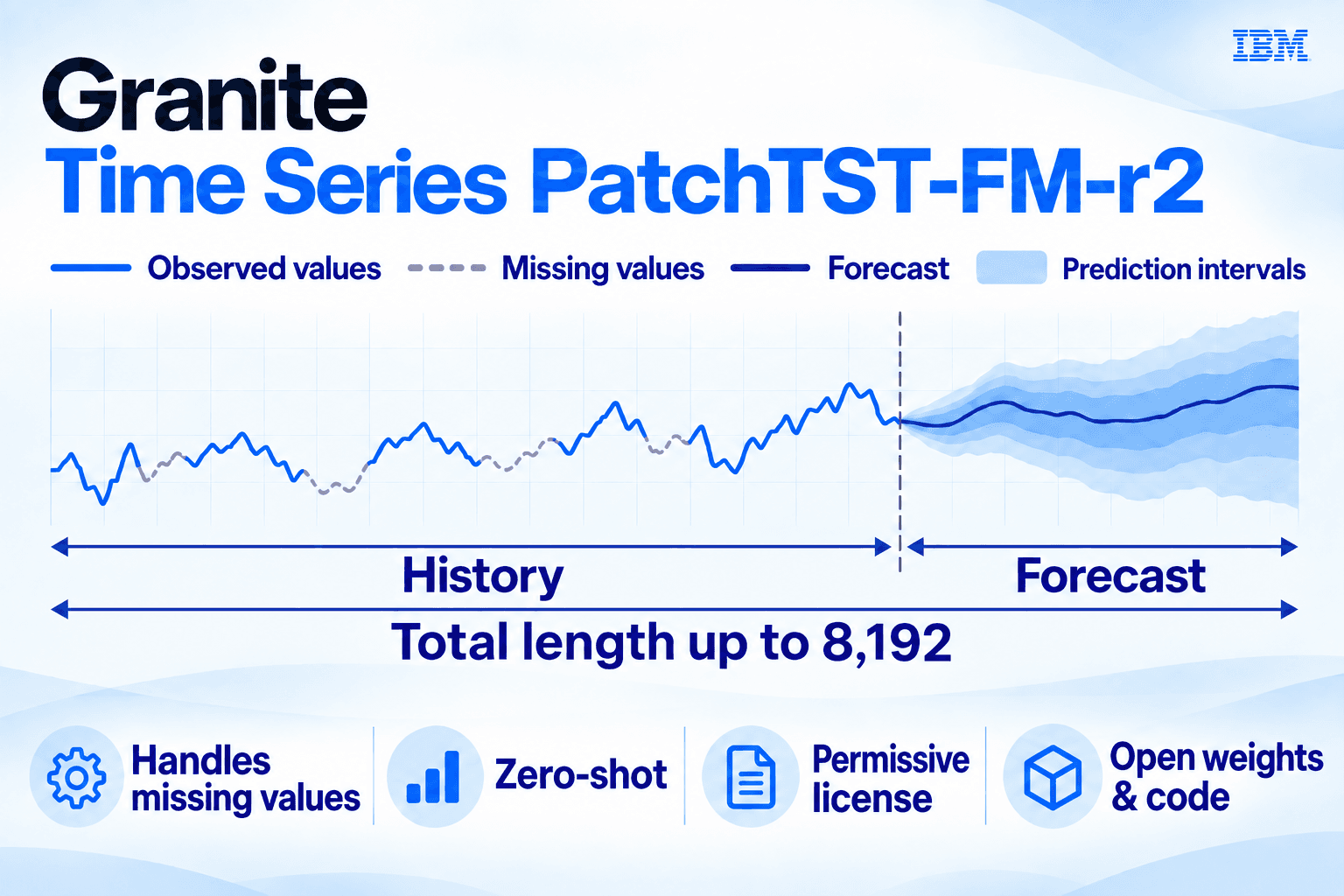
- It features a Conformer architecture, probabilistic forecasting, and support for imputing missing values.
- Dual-licensed under Apache 2.0 and OpenMDW 1.0, it offers broad, permissive rights for commercial and research use.
IBM's New Powerhouse: Deep Dive into the Granite Time Series PatchTST-FM-r2 Model
Time series forecasting is a critical part of many industries today. Whether you're predicting stock prices, energy consumption, sales trends, or server loads, getting accurate forecasts can make a huge difference. For a long time, this meant building and fine-tuning specialized models for each unique dataset. But what if you could use one powerful model that works well "out of the box" on new data, without all that extra effort? That's exactly the promise of foundation models for time series, and IBM is pushing the boundaries with its latest release: the Granite Time Series PatchTST-FM-r2 model.
Released on September 9, 2026, the PatchTST-FM-r2 model is a significant step forward in the world of time series AI. It's part of IBM's Granite family of time series foundation models, designed to offer state-of-the-art performance with a focus on practical, enterprise-grade applications.
What is the Granite Time Series PatchTST-FM-r2 Model?
At its core, the IBM Granite Time Series PatchTST-FM-r2 is a state-of-the-art, zero-shot time series forecasting model. "Zero-shot" is a key term here, meaning it can generate accurate forecasts on new, unseen time series data without needing specific fine-tuning or training for that particular task. This is a game-changer for businesses and developers who work with many diverse time series datasets, as it drastically cuts down on development and maintenance time.
The model boasts approximately 385 million parameters, making it a substantial and capable foundation model. It's the successor to PatchTST-FM-r1 and brings several important enhancements to the table. IBM Research authors announced this model in a Hugging Face blog post, highlighting its advanced architecture and performance.
Why Does it Matter for AI Practitioners and Businesses?
The release of PatchTST-FM-r2 is important for several reasons, especially for AI practitioners, data scientists, and businesses looking to leverage advanced forecasting capabilities:
- Reduced Development Overhead: The zero-shot capability means you don't need to spend countless hours collecting vast amounts of data and fine-tuning a model for every single forecasting problem. This can accelerate project timelines and reduce costs.
- Commercial-Friendly Licensing: IBM has dual-licensed the model under Apache 2.0 and the Linux Foundation's OpenMDW 1.0. Both are permissive licenses that grant broad rights to use, modify, and distribute the model for both research and commercial purposes, removing common barriers to adoption for enterprises.
- State-of-the-Art Performance: As of September 8, 2026, PatchTST-FM-r2 ranks second among replicable, zero-shot models on the comprehensive GIFT-Eval benchmark for both CRPS and MASE metrics. It's also the highest-performing model in that category released under permissive, commercial-friendly licenses. This means businesses can rely on its accuracy for critical decisions.
- Probabilistic Forecasting and Missing Value Imputation: Beyond just point forecasts, the model provides probabilistic forecasts, giving users uncertainty intervals. This is crucial for risk assessment and more informed decision-making. It also supports the imputation of missing values, a common challenge in real-world time series data.
- Transparency and Reproducibility: IBM has openly published the model weights, architecture, inference pipeline, and the code needed to reproduce its benchmark results. This level of transparency fosters trust and allows researchers and developers to understand and verify its workings.
How Does PatchTST-FM-r2 Work? A High-Level Look
The PatchTST-FM-r2 builds on the foundation of the original PatchTST and its predecessor, PatchTST-FM-r1. The core idea behind the "PatchTST" series is to break down time series data into smaller "patches" or segments. This approach has several benefits, including capturing local semantic information and improving computational efficiency by reducing the number of tokens the transformer encoder needs to process.
Here's a look at some of the key architectural and functional aspects:
- Conformer Architecture: A major upgrade in r2 is the replacement of standard transformer blocks with Conformer blocks. Conformer blocks, originally popular in speech recognition, combine multi-head self-attention with a temporal convolution layer. This hybrid design allows the convolution component to effectively capture short-range temporal patterns, while the attention mechanism can then focus on longer-range relationships between patches.
- Patching with Overlap and Weighting: The model uses 50% overlapping patches (patch length 16, stride 8) combined with Hamming-window weighting during training. At inference time, it uses an overlap-and-add forecasting technique. This intelligent patching helps in retaining local information and improving the quality of forecasts.
- Expanded Capacity: PatchTST-FM-r2 features 30 blocks, an increase from 20 in r1, allowing it to process and learn from a larger pretraining corpus. It supports context lengths up to 8,192 steps, enabling it to consider very long historical data for predictions.
- Probabilistic Forecasting: The model predicts 99 quantiles over flexible forecast lengths, providing both point forecasts and valuable uncertainty intervals. This is crucial for understanding the potential range of future outcomes, not just a single prediction.
- Training Data: The model was trained on a diverse set of data, expanded by synthetic data generated using the CauKer method. This broad training base contributes to its strong zero-shot performance.
Performance and Benchmarks: Standing Out in a Crowded Field
IBM has rigorously benchmarked PatchTST-FM-r2 on GIFT-Eval, a comprehensive benchmark for time series forecasting models. The results are impressive:
- Top Zero-Shot Performer: As of September 8, 2026, PatchTST-FM-r2 ranks second among all replicable, zero-shot models on GIFT-Eval for both CRPS (Continuous Ranked Probability Score) and MASE (Mean Absolute Scaled Error) metrics. Lower values are better for these metrics.
- Leading Permissively Licensed Model: Crucially, it stands as the highest-performing model in the zero-shot category among those released under permissive, commercial-friendly licenses.
- Competitive Against Pretrained Models: Even when compared to "pretrained" models (which are allowed to include benchmark training data in their pretraining), PatchTST-FM-r2 still performs exceptionally well, ranking third for CRPS and fourth for MASE among replicable models. It even outperforms some considerably larger pretrained models like Chronos-2, Timer-S1, and Toto variants.
These benchmarks underline the model's ability to deliver accurate and reliable forecasts across diverse datasets and scenarios without requiring extensive customization.
Accessing and Using PatchTST-FM-r2
IBM is committed to making its Granite Time Series models accessible to developers and data scientists. The PatchTST-FM-r2 model is available on the Hugging Face Hub. You can load and use the model through version 0.3.9 or later of the granite-tsfm package. The official GitHub repository for Granite TSFM also provides public notebooks, utilities, and serving components to help you get started with these models.
For those interested in streaming applications, IBM and Confluent have made several Granite Time Series models (including PatchTST-FM-r1) available through an Early Access program in Confluent Cloud, which runs foundation-model inference on live streams through Apache Flink.
What This Means for the Future of Time Series AI
The release of IBM's Granite Time Series PatchTST-FM-r2 model marks a significant milestone in time series forecasting. By combining a powerful Conformer architecture with a large, diverse pretraining corpus and a commercially friendly license, IBM is making advanced AI accessible to a broader audience.
For AI practitioners, this means less time on bespoke model development and more time on extracting insights and driving business value. For businesses, it translates to more accurate predictions, better risk management, and faster deployment of AI-powered forecasting solutions across various domains, from finance to manufacturing, retail, and energy.
As foundation models continue to evolve, we can expect to see even more sophisticated and versatile tools emerge, further simplifying complex AI tasks and opening up new possibilities for innovation.
Frequently Asked Questions
What is "zero-shot" forecasting?
Zero-shot forecasting means the model can generate accurate predictions on new time series data it has never seen before, without needing any specific fine-tuning or training for that particular dataset or task. It relies on its broad pre-training to generalize across different time series patterns.
What are the key improvements in PatchTST-FM-r2 compared to its predecessor?
PatchTST-FM-r2 introduces several key improvements, including an updated Conformer architecture, a larger and more diverse pretraining corpus, enhanced probabilistic forecasting capabilities, and support for imputing missing values. It also increases the number of architectural blocks and supports longer context lengths.
What kind of license does the IBM Granite Time Series PatchTST-FM-r2 model use?
The model is dual-licensed under the Apache 2.0 License and the Linux Foundation's OpenMDW 1.0 License. Both are permissive, open-source licenses that allow broad use, modification, and distribution for both research and commercial purposes, making it highly accessible for enterprise adoption.
Where can I access the IBM Granite Time Series PatchTST-FM-r2 model and its documentation?
You can access the model weights and details on the Hugging Face Hub. The official granite-tsfm GitHub repository provides the implementation, code, and notebooks for working with the model.