Key Takeaways
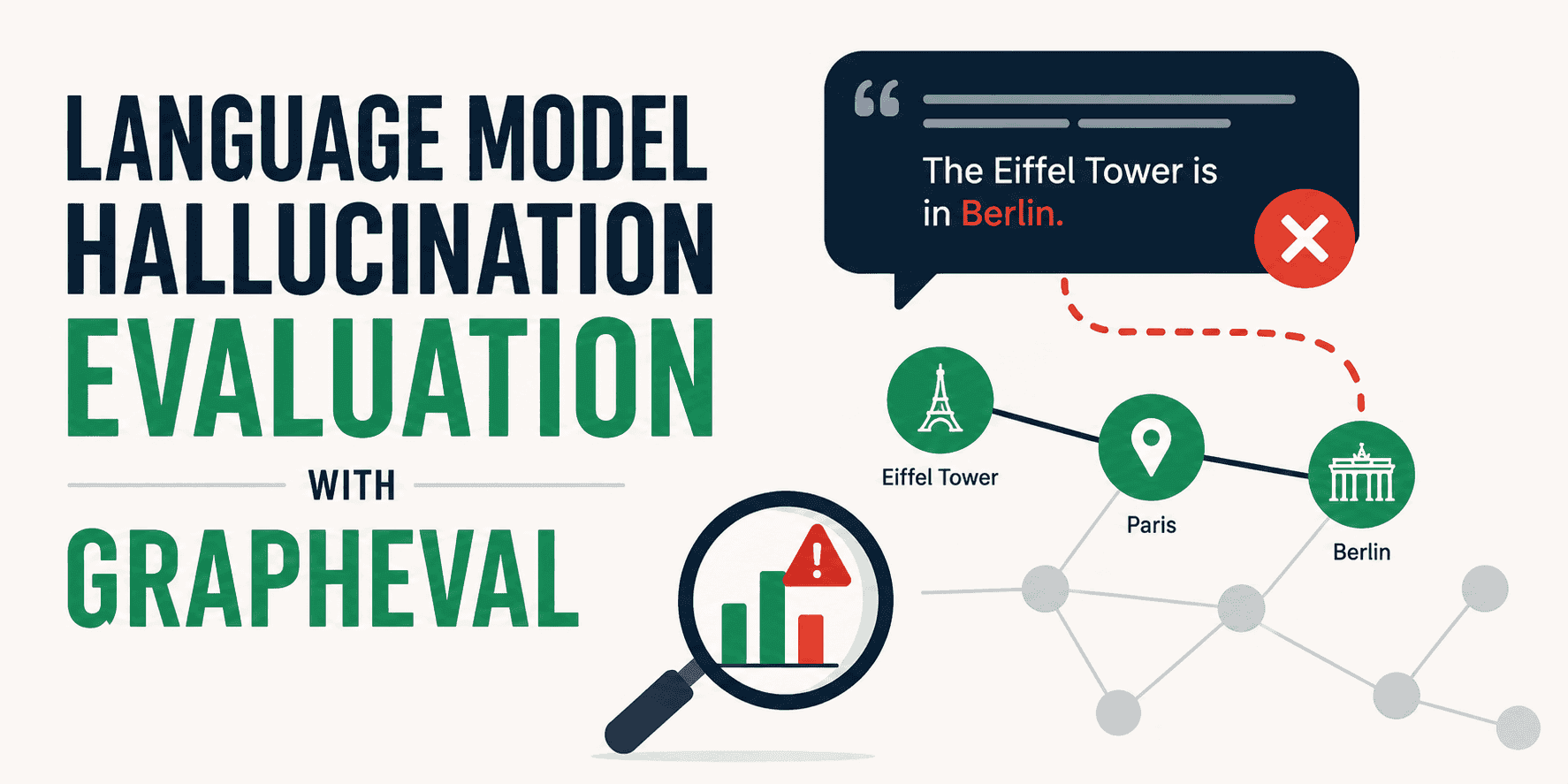
- GraphEval is a framework developed by Amazon researchers to detect and understand hallucinations in Large Language Model (LLM) outputs.
- It works by converting LLM responses into Knowledge Graphs (KGs) and then using Natural Language Inference (NLI) models to compare individual factual statements (triples) against a ground-truth context.
- A key benefit of GraphEval is its ability to offer explainability, pinpointing the specific parts of an LLM's output that are factually inconsistent.
- GraphEval has shown improved accuracy in hallucination detection on various benchmarks and also provides a pathway for correcting identified hallucinations through a method called GraphCorrect.
Large Language Models (LLMs) have transformed how we interact with information, automate tasks, and generate content. From drafting emails to coding complex applications, their capabilities seem limitless. Yet, a persistent and critical challenge remains: LLM hallucinations. These are instances where an LLM produces information that is factually incorrect, nonsensical, or simply made up, despite appearing plausible. Imagine an AI legal assistant inventing case precedents or a medical chatbot providing incorrect treatment advice – the consequences can be severe.
While the AI community has been actively working on solutions to reduce hallucinations, a crucial aspect has been less explored: robust and explainable evaluation frameworks to diagnose these inconsistencies. This is where GraphEval steps in. Proposed by a team of Amazon researchers, GraphEval offers a novel, knowledge-graph-based approach to not only detect hallucinations but also provide insights into where and how they occur.
What is GraphEval? A Knowledge-Graph Approach to Factual Consistency
At its core, GraphEval is an evaluation framework designed to assess the factual consistency of LLM-generated responses against a given context. Unlike traditional metrics that often provide a single, broad score for accuracy, GraphEval aims for a more granular and interpretable analysis. It achieves this by leveraging the power of Knowledge Graphs (KGs).
Knowledge Graphs are structured representations of information, where entities (like people, places, or concepts) are represented as nodes, and the relationships between them are represented as edges. For example, a fact like "Paris is the capital of France" can be represented as a triple: (Paris, is capital of, France). This structured format makes factual information explicit and machine-readable, which is ideal for systematic verification.
The researchers behind GraphEval, including Hannah Sansford, Nicholas Richardson, Hermina Petric Maretic, and Juba Nait Saada from Amazon, recognized that by converting an LLM's free-form text output into this structured graph format, they could systematically check each individual piece of information for consistency. The framework was presented in their paper, "GraphEval: A Knowledge-Graph Based LLM Hallucination Evaluation Framework," published on July 15, 2024.
How GraphEval Works: A Two-Stage Process
GraphEval employs a two-stage procedure to evaluate LLM outputs for hallucinations. This methodical approach is key to its effectiveness and explainability.
Stage 1: Building the Knowledge Graph from LLM Output
The first step involves transforming the LLM's natural language response into a structured Knowledge Graph. This is achieved by extracting semantic triples (Subject, Relationship, Object) from the text.
- Input: An LLM generates a response based on a prompt and potentially a source context.
- Extraction: GraphEval uses an intelligent process (which itself can involve an LLM or other NLP techniques) to parse the generated text and identify distinct factual statements. Each statement is then broken down into its core components: the subject, the relationship, and the object.
- Graph Construction: These extracted triples form the nodes and edges of a new Knowledge Graph. For instance, if an LLM outputs "Elon Musk founded SpaceX, which is an aerospace manufacturer," GraphEval would extract triples like (Elon Musk, founded, SpaceX) and (SpaceX, is an, aerospace manufacturer).
This stage essentially creates a factual blueprint of what the LLM claims to be true in its response. The clarity of this structured representation is crucial for the subsequent evaluation.
Stage 2: Fact-Checking with Natural Language Inference (NLI)
Once the Knowledge Graph is built from the LLM's output, the next stage is to fact-check each triple against a reliable source of truth, known as the "ground-truth context."
- Ground-Truth Context: This context represents the factual information that the LLM should have adhered to. In a Retrieval-Augmented Generation (RAG) system, this might be the retrieved documents from a vector database. For evaluation, it's the trusted source of knowledge.
- Natural Language Inference (NLI): GraphEval utilizes state-of-the-art NLI models for this critical step. An NLI model takes two text snippets – a "premise" and a "hypothesis" – and determines the relationship between them:
- Entailment: The hypothesis is true given the premise.
- Contradiction: The hypothesis contradicts the premise.
- Neutral: The hypothesis is neither entailed by nor contradicts the premise.
- Triple Evaluation: Each semantic triple extracted from the LLM's output (the hypothesis) is compared against the ground-truth context (the premise) using an NLI model. If the NLI model identifies a triple as "contradiction" or "neutral" with respect to the context, that specific triple is flagged as a hallucination.
This granular evaluation means GraphEval doesn't just say "the response is good" or "the response is bad." Instead, it can point to "this specific fact about X is incorrect" or "that relationship between Y and Z is not supported by the context."
Why GraphEval Matters for AI Practitioners
For anyone working with or building on LLMs, GraphEval offers significant advantages that address some of the most pressing concerns in AI development and deployment.
Explainable Hallucination Detection
Perhaps the most compelling feature of GraphEval is its explainability. Traditional methods often struggle to identify the exact source of an LLM's factual error. GraphEval, by breaking down the output into discrete factual triples, can highlight precisely which statements are inconsistent with the provided context. This is invaluable for debugging LLMs, understanding their failure modes, and refining their training or prompting strategies. Developers can see not just that a hallucination occurred, but where it occurred.
Improved Evaluation Accuracy
The research paper indicates that GraphEval, when used in conjunction with state-of-the-art NLI models, leads to an improvement in balanced accuracy on various hallucination benchmarks. For instance, it demonstrated an average improvement of 6.2% (with a standard error of 1.3) on three popular hallucination benchmarks. This suggests that GraphEval provides a more reliable and effective way to measure an LLM's factual consistency compared to using NLI models alone or other conventional metrics.
Pathway to Correction: GraphCorrect
Beyond just detection, GraphEval also opens doors for systematic hallucination correction. The researchers introduced a method called "GraphCorrect," which leverages the structured nature of the KG to rectify inconsistencies. Once a hallucinated triple is identified, GraphCorrect employs a two-step procedure:
- The identified triple and the ground-truth context are fed into an LLM.
- The LLM is prompted to correct the potential hallucination within the triple, resulting in a newly generated, corrected triple.
This demonstrates the potential for GraphEval to be part of a closed-loop system for improving LLM reliability, moving from detection to automated (or semi-automated) correction.
Building Trustworthy AI
For applications where factual accuracy is paramount – such as financial reporting, medical information, legal analysis, or news generation – hallucinations are a major blocker to adoption. GraphEval provides a robust framework for increasing confidence in LLM outputs. By systematically verifying information at a granular level, it helps build more trustworthy AI systems, which is crucial for their broader integration into critical sectors. This is especially important for Retrieval-Augmented Generation (RAG) systems, where LLMs are expected to synthesize information directly from provided source documents.
Practical Implications and Use Cases
The principles and methodology of GraphEval have significant practical implications for various AI practitioners:
- For RAG System Developers: GraphEval can be integrated into the evaluation pipeline of RAG systems to ensure that generated responses are truly grounded in the retrieved documents. This helps verify that the LLM is not "inventing" information even when provided with a relevant context. The KDnuggets article highlights how ground-truth knowledge in a production setting would likely stem from retrieving relevant documents from a RAG system's vector database.
- For Content Creators and Journalists: When LLMs are used for drafting articles, summaries, or reports, GraphEval can act as a crucial fact-checking layer. It can quickly identify specific statements that might be ungrounded or contradictory, allowing human editors to focus their efforts on verifying flagged information rather than sifting through entire texts.
- For MLOps Teams: Monitoring the factual integrity of LLMs in production is a complex task. GraphEval can be incorporated into MLOps pipelines to continuously evaluate model outputs against evolving knowledge bases, triggering alerts when hallucination rates exceed acceptable thresholds or when specific types of factual errors become prevalent.
- For Researchers and Academics: GraphEval provides a powerful tool for analyzing the behavior of LLMs, understanding different types of hallucinations, and developing new methods to mitigate them. Its explainable nature makes it an excellent diagnostic tool for advanced AI research.
The Road Ahead for Hallucination Management
GraphEval represents a significant step forward in our ability to evaluate and combat LLM hallucinations. As LLMs become more sophisticated and are deployed in increasingly sensitive applications, robust and explainable evaluation frameworks like GraphEval will become indispensable. The ongoing research in this area will likely lead to even more refined methods for KG construction, more accurate NLI models, and advanced techniques for automated hallucination correction.
The focus on structured data representation through knowledge graphs provides a solid foundation for building more reliable and transparent AI systems. By understanding not just if an LLM hallucinates, but how and where, we can steer the development of AI towards a future where factual integrity is a default, not just an aspiration.
Frequently Asked Questions
What problem does GraphEval specifically solve?
GraphEval addresses the critical problem of evaluating and detecting factual inconsistencies, often called hallucinations, in the outputs generated by Large Language Models (LLMs). It also provides explainability by pinpointing the exact parts of an LLM's response that are factually incorrect or ungrounded.
Who developed GraphEval and when was it released?
GraphEval was developed by a team of Amazon researchers: Hannah Sansford, Nicholas Richardson, Hermina Petric Maretic, and Juba Nait Saada. Their research paper was published on July 15, 2024.
How does GraphEval use Knowledge Graphs?
GraphEval uses Knowledge Graphs (KGs) to represent the information contained in an LLM's output. It converts the LLM's response into a series of semantic triples (Subject, Relationship, Object). Each of these triples is then individually checked against a ground-truth context using Natural Language Inference (NLI) models to identify factual inconsistencies.
Can GraphEval also correct hallucinations?
Yes, the researchers introduced a method called GraphCorrect, which extends GraphEval's capabilities to correct identified hallucinations. This involves feeding the problematic triple along with the context back into an LLM to generate a corrected version.