Key Takeaways
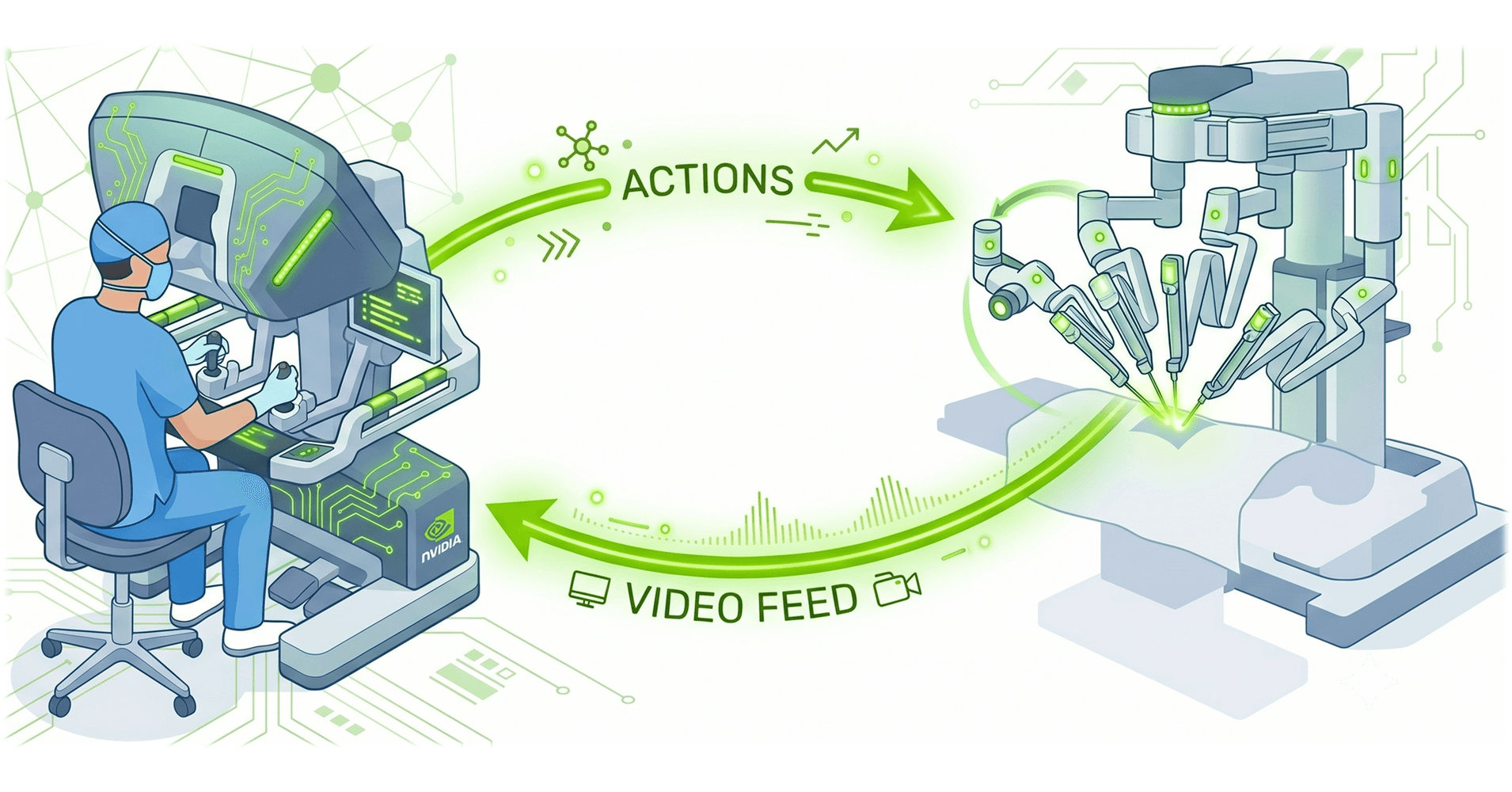
- NVIDIA Cosmos-H-Dreams is a real-time, generative AI simulator for surgical robotics, allowing interactive control within a synthesized surgical scene.
- It learns visual dynamics directly from surgical video and robot kinematics, bypassing traditional, complex physics-based modeling for deformable tissues and fine instrument interactions.
- This research platform, part of the broader NVIDIA Isaac for Healthcare and Medical Physics Simulation framework, aims to accelerate surgical robot training, policy evaluation, and synthetic data generation.
- Running on a single NVIDIA RTX PRO 6000 GPU, it achieves high frame rates, enabling human operators or learned AI policies to interact in a closed-loop virtual environment.
NVIDIA Cosmos-H-Dreams: Real-Time Generative Simulation for Surgical Robotics
The field of surgical robotics is rapidly advancing, moving beyond simple teleoperation to embrace sophisticated AI-driven systems. These advanced robots promise greater precision, consistency, and potentially new surgical techniques. However, developing, testing, and training these complex systems presents significant challenges. Traditional methods are slow, expensive, and carry inherent risks. This is where NVIDIA's latest innovation, Cosmos-H-Dreams, steps in, offering a groundbreaking approach to real-time generative simulation in surgical robotics. This article dives deep into what Cosmos-H-Dreams is, why it's a game-changer for medical robotics, how it leverages cutting-edge AI, and what its implications are for practitioners and the future of healthcare.The Challenge of Surgical Robotics Development
Training and evaluating surgical robots is incredibly difficult. Physical robotic platforms are costly to operate, and experiments are hard to reproduce consistently. More importantly, failures during real-world testing can damage delicate instruments or, in a clinical setting, biological material. Conventional simulators offer a safer alternative, but creating realistic surgical scenes for these simulators is exceptionally complex. You have to accurately model deformable tissues, the intricate interactions of fine instruments, specular (shiny) surfaces, sutures, needles, smoke, and occlusions – all of which are crucial for a truly lifelike simulation. Building these traditional physics-based models requires immense manual effort and expertise.What is NVIDIA Cosmos-H-Dreams?
NVIDIA Cosmos-H-Dreams is a real-time, action-conditioned generative simulator specifically designed for surgical robotics. It's an interactive environment where a person or a learned AI policy can control a surgical robot within a synthesized video environment and observe the interactions live. Instead of relying on manually authored objects and physical interactions, Cosmos-H-Dreams leverages "world foundation models" that learn visual dynamics directly from synchronized surgical video and robot kinematics. This means it predicts what the camera would see next based on an initial scene and a sequence of robot actions, effectively generating future surgical video. This project builds upon its predecessor, Cosmos-H-Surgical-Simulator, which was an action-conditioned world foundation model built on NVIDIA Cosmos-Predict2.5-2B and trained on the Open-H-Embodiment dataset. While the Surgical-Simulator was useful for offline policy evaluation and synthetic data generation, Cosmos-H-Dreams distills these capabilities into a causal, few-step "student model" that runs interactively in real time.Why Real-Time Generative Simulation Matters for Surgical Robotics
The introduction of Cosmos-H-Dreams marks a significant step forward for several reasons:- Accelerated Training and Evaluation: It provides a "virtual training ground" where medical robots can learn and be evaluated in thousands of simulated procedures at once. This helps identify problems much earlier in development, saving costly lab time and bringing innovations to market faster. Benchmarks show that running 8,192 robot-training environments in parallel with GPU-native simulation can cut training time from over five hours to under two minutes.
- Synthetic Data Generation: The system can generate vast amounts of high-quality synthetic data. This data is crucial for training and evaluating AI models and behavior cloning models, especially for complex surgical tasks, without the need for real-world data collection which can be difficult and expensive.
- Safe Exploration of Edge Cases: Rare or difficult-to-reproduce scenarios, which are critical for understanding robot behavior and failure modes, can be easily generated and explored in the simulation. This allows developers to thoroughly test robotic systems before moving to physical prototypes and lab testing.
- Interactive Development: Running in real-time on a single NVIDIA RTX PRO 6000 GPU at around 160 frames per second, Cosmos-H-Dreams creates an interactive environment. This allows human operators to control the robot in a closed loop or for learned AI policies to be dropped into the same loop, enabling rapid iteration and refinement.
- Patient-Specific Simulations: Companies like CMR Surgical and Cambridge Consultants are already using Cosmos-H-Dreams to create patient-specific surgical simulations by modeling complex interactions between surgical instruments and soft tissue.
How Cosmos-H-Dreams Works: A High-Level Overview
Cosmos-H-Dreams operates on a fascinating principle that departs from traditional physics engines for modeling visual dynamics. Here's a breakdown: 1.Learning Visual Dynamics from Data
Instead of manually programming every physical interaction (like tissue deformation, instrument friction, etc.), Cosmos-H-Dreams learns these visual dynamics directly from paired surgical video and robot kinematics. This is achieved through "world foundation models" like NVIDIA Cosmos-Predict2.5-2B, which are trained on extensive datasets like Open-H-Embodiment. 2.Action-Conditioned Generation
The model takes an initial camera frame and a stream of robot movements (kinematic actions) as input. It then autoregressively generates predicted future visual consequences in successive blocks of frames. This means it predicts what the surgical scene will look like after the robot performs certain actions. 3.Distillation for Real-Time Performance
The original Cosmos-H-Surgical-Simulator was an offline model. To achieve real-time interactivity, NVIDIA distilled its capabilities into a more efficient "causal, few-step student model." This student model is trained to continue generating from its own generated history, a process called "self-forcing distillation." It produces each latent frame in fewer denoising steps than its teacher model. 4.Accelerated Inference with FlashDreams
The distilled model is served through FlashDreams, NVIDIA's accelerated streaming-inference library. This library optimizes the process by holding a rolling cache of past frames, contributing to the high frame rates achieved. 5.GPU Acceleration
The entire system runs efficiently on a single NVIDIA RTX PRO 6000 GPU, demonstrating the power of NVIDIA's specialized hardware for AI inference and real-time rendering. It's important to note that Cosmos-H-Dreams generates action-conditioned video rollouts and functions as a learned world simulation. It does not propose a trajectory, issue motor commands, or control a physical surgical robot directly. It's a simulation tool for research and development, not a diagnostic system or a replacement for intraoperative imaging.Part of a Larger Ecosystem: NVIDIA Isaac for Healthcare
Cosmos-H-Dreams is a key component within NVIDIA's broader strategy for healthcare robotics. It is part of the NVIDIA Isaac for Healthcare platform, which is purpose-built for developing healthcare robots. This platform includes:- NVIDIA Omniverse: A platform for building and operating 3D industrial digitalization applications, used for creating photorealistic and physically accurate surgical theaters and digital twins.
- NVIDIA Isaac Sim: An extensible robotics simulation application and synthetic data generation tool built on Omniverse, providing realistic simulation environments for training.
- NVIDIA Isaac Lab: A modular framework for robot learning, also built on Isaac Sim, supporting various libraries for reinforcement learning and imitation learning.
- Medical Physics Simulation Framework: An open-source, GPU-accelerated capability within Isaac for Healthcare that combines classical physics simulation with generative AI physics simulation (like Cosmos-H-Dreams) to model anatomy-device interaction, generate scenarios, and train robot policies.
- NVIDIA Holoscan: For on-robot deployment and real-time sensor processing, ensuring low-latency execution in clinical settings.
Benefits for AI Practitioners and Medical Innovators
For AI practitioners, researchers, and medical technology developers, Cosmos-H-Dreams and the surrounding NVIDIA ecosystem offer unprecedented capabilities: Rapid Prototyping and Iteration: Developers can quickly test new robot control policies and algorithms in a virtual environment, drastically reducing the development cycle. Access to Diverse Scenarios: The generative nature of the simulator allows for the creation of an almost infinite variety of surgical scenarios, including rare complications or anatomical variations that would be impossible to gather enough data for in the real world. Ethical and Safe Development: Training and testing in a simulation eliminate risks to patients and expensive physical hardware, making the development process safer and more ethical. Foundation for Future AI: By providing a reliable way to generate synthetic data and evaluate policies, Cosmos-H-Dreams lays the groundwork for more autonomous and intelligent surgical robots. It enables the exploration of "physical AI" where models learn about and interact with the physical world.• Collaboration and Open Science: The Medical Physics Simulation framework, which includes Cosmos-H-Dreams, is open source. This fosters collaboration and allows healthcare teams to access and build upon shared simulation tools and AI models, accelerating industry-wide progress in surgical robotics. The code and a specialized checkpoint are available on Hugging Face.
Challenges and Future Outlook
While incredibly promising, generative simulation for surgical robotics is still an evolving field. One challenge is the regulatory landscape; current FDA guidance for simulation evidence in medical-device submissions primarily covers physics-based models, not directly establishing a validation route for learned generative video world models. Proving that generated visual dynamics reliably predict physical robot outcomes beyond tabletop tasks will be crucial for broader adoption. However, as model fidelity, temporal stability, and hardware efficiency continue to improve, real-time generative simulation, powered by platforms like Cosmos-H-Dreams, can connect surgeon education, synthetic data generation, policy training, and policy evaluation within one shared Physical AI environment. This could fundamentally reshape how surgical robots are designed, trained, and integrated into future operating rooms.Conclusion
NVIDIA Cosmos-H-Dreams represents a significant leap forward in surgical robotics, moving us closer to a future where AI-powered systems can augment human surgeons with superhuman precision. By combining generative AI with real-time simulation, NVIDIA is tackling some of the biggest bottlenecks in healthcare robotics development. This technology not only accelerates the training and evaluation of robotic systems but also opens up new avenues for safer, more efficient, and ultimately more effective surgical procedures. For AI practitioners, it's a powerful demonstration of how advanced AI can solve complex real-world problems and contribute to life-saving innovations in medicine.Frequently Asked Questions
What is the main purpose of NVIDIA Cosmos-H-Dreams?
The main purpose of NVIDIA Cosmos-H-Dreams is to provide a real-time, action-conditioned generative simulator for surgical robotics. It allows researchers and developers to interactively control a surgical robot within a synthesized virtual environment to train and evaluate AI policies and generate synthetic data.
How does Cosmos-H-Dreams differ from traditional surgical simulators?
Unlike traditional simulators that rely on complex, manually authored physics-based models for tissue and instrument interactions, Cosmos-H-Dreams uses generative AI to learn visual dynamics directly from real surgical video and robot kinematics. This allows it to predict future visual scenes in real-time based on robot actions, bypassing the need for explicit physics engines for every detail.
Is Cosmos-H-Dreams a commercial product available for purchase?
NVIDIA Cosmos-H-Dreams is currently a research and development platform, not a diagnostic system or a commercial product for direct purchase by end-users. It is part of the open-source NVIDIA Medical Physics Simulation framework and the broader NVIDIA Isaac for Healthcare platform, which provides tools and components for developers. The code and a specialized model checkpoint are available on Hugging Face.
What hardware is required to run Cosmos-H-Dreams?
Cosmos-H-Dreams is designed to run efficiently on a single NVIDIA RTX PRO 6000 GPU, achieving interactive frame rates of around 160 frames per second.