Key Takeaways
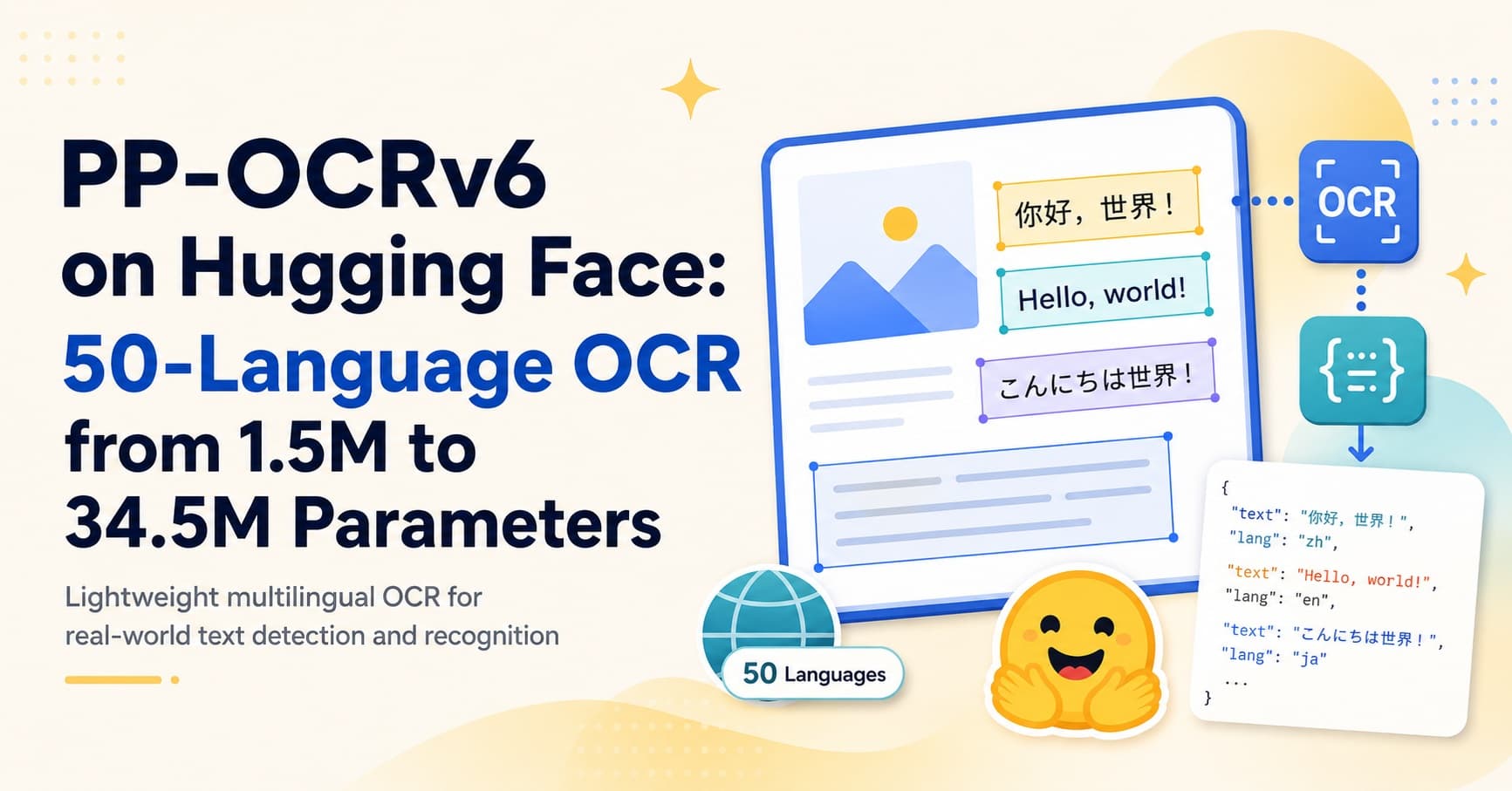
- PP-OCRv6 is the latest version of Baidu's PaddleOCR, offering highly efficient and accurate Optical Character Recognition (OCR) across 50 languages.
- It features three model sizes (tiny, small, medium) ranging from 1.5M to 34.5M parameters, designed for flexible deployment from edge devices to powerful servers.
- PP-OCRv6 introduces architectural improvements like PPLCNetV4 backbone, RepLKFPN for detection, and EncoderWithLightSVTR for recognition, leading to significant accuracy gains over previous versions.
- The models are readily available on Hugging Face, allowing easy integration into AI projects using the Transformers library or other backends like PaddlePaddle and ONNX Runtime.
PP-OCRv6 on Hugging Face: A Deep Dive into Multi-Language OCR for AI Practitioners
In the fast-evolving world of Artificial Intelligence, Optical Character Recognition (OCR) remains a fundamental technology. It's the bridge that turns images of text into machine-readable data, powering everything from document digitization to intelligent automation. Today, we're taking a close look at a significant advancement in this field: PP-OCRv6, now accessible on Hugging Face. This latest iteration from Baidu's PaddleOCR team brings a blend of cutting-edge accuracy, efficiency, and extensive multi-language support, making it a powerful tool for developers and AI practitioners alike.
What Exactly is PP-OCRv6?
PP-OCRv6 is the newest generation in the PaddleOCR family, an open-source OCR system developed by Baidu Inc. At its core, PP-OCRv6 is designed to accurately detect and recognize text from various real-world scenarios, including documents, screenshots, multilingual images, digital displays, and industrial labels. What makes this release particularly noteworthy is its scalability, offering a range of models from a tiny 1.5 million parameters up to a more robust 34.5 million parameters.
This model family is not just about raw power; it's about practical application. It aims to deliver accurate, structured text outputs while keeping model sizes manageable for diverse deployment needs.
The Backbone: Understanding PaddleOCR
To appreciate PP-OCRv6, it's helpful to understand its parent project, PaddleOCR. Launched by Baidu, PaddleOCR is a comprehensive, open-source OCR toolkit built on their PaddlePaddle deep learning framework. It has consistently focused on providing robust text detection and recognition capabilities across numerous languages, emphasizing both high accuracy and ease of use. The project's philosophy centers on creating practical, ultra-lightweight OCR tools that help users train better models and apply them in real-world situations.
PaddleOCR typically follows a two-stage pipeline: first, text detection to locate text regions in an image, and then text recognition to convert those detected regions into readable characters.
Why PP-OCRv6 Matters for AI Practitioners
PP-OCRv6 brings several compelling advantages that address common pain points in OCR and open up new possibilities:
- Unprecedented Multi-Language Support: The medium and small tiers of PP-OCRv6 support 50 languages. This includes major languages like Simplified Chinese, Traditional Chinese, English, and Japanese, along with 46 Latin-script languages. This broad coverage means developers can use a single model family for global applications, reducing the complexity of managing multiple language-specific models.
- Scalable Efficiency: With three distinct model tiers – tiny (1.5M parameters), small (7.7M parameters), and medium (34.5M parameters) – PP-OCRv6 offers flexibility for different deployment environments. The tiny model is perfect for edge devices, lightweight local OCR, and latency-sensitive demos, while the medium model is geared towards accuracy-oriented server-side pipelines and industrial OCR.
- Improved Accuracy and Performance: Compared to its predecessor, PP-OCRv5_server, PP-OCRv6_medium shows significant improvements, boosting text detection by +4.6 percentage points and text recognition by +5.1 percentage points on PaddleOCR's in-house benchmarks. The tiny tier also achieves faster inference, up to 3.9 times faster than PP-OCRv5_mobile on an Intel Xeon CPU while keeping comparable accuracy.
- Outperforming Larger Models: Remarkably, PP-OCRv6_medium can surpass the performance of much larger Vision-Language Models (VLMs) like Qwen3-VL-235B, GPT-5.5, and Gemini-3.1-Pro on OCR tasks, despite having orders of magnitude fewer parameters. This highlights the power of specialized, lightweight architectures for specific tasks.
- Easy Integration via Hugging Face: The availability of PP-OCRv6 on Hugging Face means it can be easily integrated into projects using the popular Transformers library, as well as other backends like PaddlePaddle and ONNX Runtime. This simplifies access and deployment for the AI community.
How PP-OCRv6 Works: Architectural Innovations
PP-OCRv6 introduces several key architectural, training, and data improvements across both text detection and recognition stages. The main goal was to boost OCR accuracy while keeping model sizes flexible for various deployment needs.
Unified Backbone and Detection
A significant change is the use of PPLCNetV4 as a unified backbone for both text detection and text recognition. This consistency across the model family helps streamline development. For text detection, which is the first crucial step in the OCR pipeline, PP-OCRv6 upgrades its module with RepLKFPN (Reparameterizable Large-Kernel Feature Pyramid Network). This lightweight network is specifically designed for multi-scale text detection, even when text is small, dense, rotated, low-resolution, or in complex backgrounds, all while maintaining efficient inference.
Advanced Recognition
For text recognition, PP-OCRv6 employs EncoderWithLightSVTR. This component combines local context modeling with global attention mechanisms to improve recognition quality, especially for diverse and challenging text types.
These innovations work together to create a more accurate and efficient OCR system, capable of handling a wide array of real-world text images.
Real-World Implications for AI Practitioners and Developers
The capabilities of PP-OCRv6 translate directly into practical benefits for anyone working with text extraction from images:
- Document Processing Automation: For businesses dealing with large volumes of documents – invoices, contracts, forms – PP-OCRv6 can automate data extraction with higher accuracy and speed. This reduces manual effort and errors.
- Enhanced Data Entry: Developers building applications that require converting handwritten notes, scanned receipts, or digital displays into structured data can leverage PP-OCRv6 for more reliable input.
- Accessibility Solutions: Tools designed to make visual information accessible to individuals with visual impairments can use PP-OCRv6 to convert text in images into spoken word or braille, supporting a wider range of languages.
- Global Application Development: With its 50-language support, developers can create applications that cater to a global user base without needing to integrate and maintain multiple OCR engines for different regions.
- Edge and Mobile AI: The tiny and small models are perfect for deploying OCR directly on mobile devices or edge hardware, enabling real-time processing without relying on cloud infrastructure. This is crucial for applications with privacy concerns or limited internet connectivity.
- AI Research and Development: Researchers can use PP-OCRv6 as a strong baseline or integrate it into larger multimodal models, benefiting from its specialized OCR performance.
Getting Started with PP-OCRv6 on Hugging Face
The easiest way to explore and integrate PP-OCRv6 is through the Hugging Face Hub. The PaddleOCR team has made various models available, including detection and recognition models in different sizes (tiny, small, medium) and formats (safetensors, Paddle inference models, ONNX models).
You can find the official PaddleOCR models and related resources on the PaddlePaddle Hugging Face organization page. For hands-on use, the PaddleOCR GitHub repository is an excellent resource, providing documentation and examples for integration.
To use PP-OCRv6, you would typically:
- Install the necessary libraries, including the Hugging Face Transformers library and PaddlePaddle.
- Load the desired PP-OCRv6 model (e.g., a detection model and a recognition model) using the Transformers API.
- Preprocess your input image.
- Pass the image through the detection model to find text bounding boxes.
- Crop the detected text regions and pass them to the recognition model to extract the actual text.
PaddleOCR also offers an online demo to quickly evaluate PP-OCRv6's capabilities without any setup.
Looking Ahead
PP-OCRv6 represents a clear direction in AI development: specialized, efficient models that can outperform generalist large models on specific tasks. As AI continues to become more integrated into daily life and industrial processes, tools like PP-OCRv6 will be crucial for handling the vast amounts of visual information that need to be converted into actionable data. Its focus on lightweight design, high accuracy, and broad language support makes it a standout choice for developers looking for robust OCR solutions today and in the future.
Frequently Asked Questions
What is the main advantage of PP-OCRv6 over previous versions?
PP-OCRv6 offers significant improvements in both text detection and recognition accuracy, with the medium tier achieving +4.6% in detection and +5.1% in recognition compared to PP-OCRv5_server. It also introduces architectural enhancements and better scalability with its three model tiers, from tiny to medium, supporting 50 languages.
Who developed PP-OCRv6 and the PaddleOCR project?
PP-OCRv6 is part of the PaddleOCR project, which is an open-source initiative developed by Baidu Inc.
Can PP-OCRv6 be used for languages other than English and Chinese?
Yes, the small and medium tiers of PP-OCRv6 support 50 languages. This includes Simplified Chinese, Traditional Chinese, English, Japanese, and 46 other Latin-script languages, making it a highly versatile multilingual OCR solution.
Are there different sizes of PP-OCRv6 models available?
Yes, PP-OCRv6 comes in three model tiers: tiny (1.5M parameters), small (7.7M parameters), and medium (34.5M parameters). These different sizes allow for flexible deployment based on computational resources and accuracy requirements, from edge devices to powerful servers.