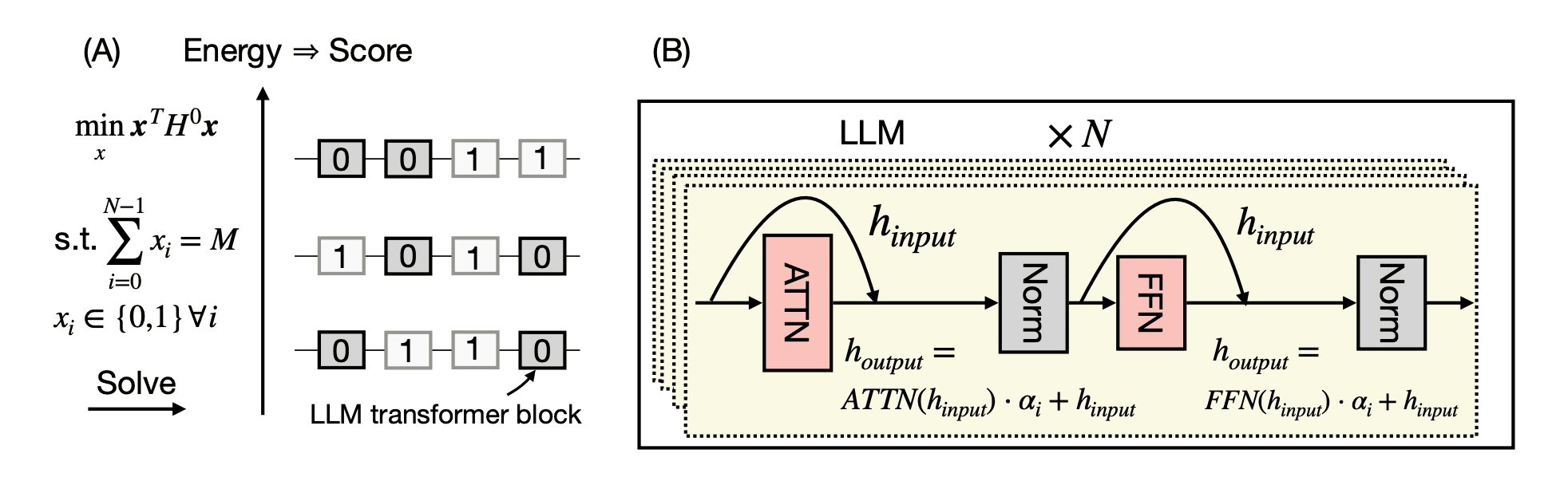
The core paper is "LLM Compression by Block Removal with Constrained Binary Optimization". It was published on arXiv on January 29, 2026. The abstract mentions formulating block removal as a constrained binary optimization (CBO) problem that maps to an Ising glass. The paper claims significant performance gains, especially in deep compression regimes (e.g., 50% compression of Llama-3.3-70B-Instruct, with a 23 percentage point increase on MMLU compared to other SOTA methods). For lighter compression, it performs on par with other methods. The approach is computationally efficient, requiring only forward and backward passes on a calibration dataset for a few active parameters. It also demonstrates generality by applying it to the NVIDIA-Nemotron-3-Nano-30B-A3B-FP8 model.
The research seems to be from Multiverse, as indicated by the vertexaisearch link description mentioning "Multiverse" in the context of "hand the hard instances to the same classical and quantum-inspired solvers we use elsewhere at Multiverse". However, the arXiv paper itself lists authors without explicit company affiliation in the abstract. It's a research paper, not a direct tool launch with pricing.
I have enough information to proceed with the article structure.
Plan for Article Content:
1. Key Takeaways: Summarize the core idea, benefits, and target audience.
2. Introduction: Set the stage for LLM efficiency and the problem of pruning. Introduce the "physicist's approach."
3. The Challenge of LLM Pruning: Explain why large language models are difficult to prune effectively, especially with structured pruning (removing blocks). Mention existing methods like magnitude-based, activation-based, and structured pruning (head, layer, neuron pruning).
4. Enter the Ising Model: A Physicist's Solution:
Explain what an Ising model is in simple terms (spins, energy, interactions).
Describe how the research maps the LLM block removal problem to an Ising optimization problem.
Introduce "constrained binary optimization (CBO)" as the mathematical framework.
Explain that block removal is treated as a binary decision (keep/remove), and the "energy" of the Ising system acts as a proxy for the pruned model's performance.
5. How Block Removal as Ising Optimization Works (High-Level):
The goal: find an optimal configuration of blocks to remove while maintaining performance.
The "spins" represent the blocks (e.g., Transformer layers, attention heads, FFN layers).
The "interactions" capture the dependencies between blocks.
The "energy function" guides the search for the best pruning mask, balancing sparsity and accuracy.
Mention that this allows ranking many configurations without full benchmarking and can use classical or quantum-inspired solvers.
6. Why This Approach Matters:
Superior Performance: Especially in deep compression, outperforming existing methods (e.g., 23 percentage points on MMLU for Llama-3.3-70B-Instruct at 50% compression).
Computational Efficiency: Requires only forward/backward passes on a calibration dataset.
Global Optimization: Finds non-trivial solutions beyond just removing consecutive regions.
Generality: Applicable to various LLM architectures, including those with inhomogeneous structures like NVIDIA-Nemotron-3-Nano-30B-A3B-FP8.
Practical Implications: Smaller, faster, more cost-effective LLMs for deployment, especially on edge devices.
7. The Researchers Behind the Breakthrough: Identify the paper "LLM Compression by Block Removal with Constrained Binary Optimization" and its publication on arXiv in January 2026. Mention the affiliation with Multiverse (as hinted by the search result).
8. Looking Ahead: The Future of Efficient LLMs: Discuss the broader impact on LLM development, accessibility, and new possibilities.
9. Conclusion.
10. FAQ.
Word count check: I need to ensure the article is at least 1000 words. Each section will need to be sufficiently detailed.
I will make sure to use plain English and avoid jargon where possible, or explain it clearly.
You Might Also Like

Sep 22, 2026·12 min· new
7 Open-Source Alternatives to ChatGPT You Can Run Locally
In the rapidly evolving world of Artificial Intelligence, Large Language Models (LLMs) like ChatGPT have changed how we interact with technology. However, relying solely on cloud-based services often ...

Sep 22, 2026·11 min· new
What Everyone Is Getting Wrong About TypeSafe AI's Jev
The world of Artificial Intelligence moves at an incredible pace, with new tools and models emerging constantly. Among the latest to capture significant attention is Jev, from TypeSafe AI. Heralded by...
Sep 19, 2026·9 min· new
Reusing the Prompt Prefix with a Key-Value Cache for SLM Optimization
Small Language Models (SLMs) are becoming incredibly important in many AI applications. They offer a great balance of performance and efficiency, especially when compared to their larger counterparts....