Key Takeaways
- Reusing prompt prefixes with a Key-Value (KV) cache is a smart way to make Small Language Models (SLMs) run faster and more efficiently.
- This technique stores the computed "keys" and "values" from common prompt beginnings, avoiding repetitive calculations.
- It significantly reduces inference latency, lowers computational costs, and boosts the overall throughput of SLMs.
- AI practitioners can use this method to deploy SLMs more cost-effectively and deliver quicker responses in applications.
Small Language Models (SLMs) are becoming incredibly important in many AI applications. They offer a great balance of performance and efficiency, especially when compared to their larger counterparts. But even with SLMs, getting the most out of them means constantly looking for clever optimization techniques. One such technique, which is gaining traction for its effectiveness, is reusing the prompt prefix with a Key-Value (KV) cache.
This approach directly addresses a common bottleneck in how transformer-based models process information, especially when dealing with prompts that share common beginnings. Let's dive deep into what this means, why it's so powerful, and how it works.
What Are Small Language Models (SLMs)?
Before we talk about optimization, it's good to clarify what SLMs are. Think of SLMs as the more compact, agile siblings of large language models (LLMs). While LLMs like GPT-4 or Gemini boast billions or even trillions of parameters, SLMs typically range from hundreds of millions to a few billion parameters.
The beauty of SLMs lies in their ability to perform well on specific tasks or domains without needing the massive computational resources of LLMs. They are often faster to train, cheaper to run, and can be deployed on less powerful hardware, making them ideal for edge devices, specialized applications, and scenarios where quick responses are critical. Examples include models like Microsoft's Phi-3 or Google's Gemma.
However, even with their smaller size, optimizing SLMs is still crucial. Every millisecond saved and every computational cycle reduced contributes to a more efficient and scalable AI system.
The Challenge: Repetitive Computations in Transformers
At the heart of most modern language models, including SLMs, is the transformer architecture. Transformers are excellent at understanding context and relationships between words in a sequence, largely thanks to their self-attention mechanism.
When you feed a prompt into a transformer model, it processes each token (word or sub-word) in the sequence. For every token, the self-attention mechanism calculates "query," "key," and "value" vectors. These vectors are then used to determine how much attention each token should pay to every other token in the sequence to understand its context.
Here's where the inefficiency can creep in: imagine you're interacting with an SLM, asking it a series of questions that start with the same phrase, like:
- "Summarize this article: The quick brown fox..."
- "Summarize this article: The lazy dog..."
- "Summarize this article: The jumping cat..."
In each of these prompts, the prefix "Summarize this article:" is identical. Without optimization, the model would re-compute the query, key, and value vectors for this identical prefix every single time. This is a redundant and computationally expensive process, especially in applications that frequently use similar prompt structures or in conversational AI where previous turns are often prefixes for new ones.
Understanding the Key-Value Cache (KV Cache)
This is where the Key-Value (KV) cache comes into play. To understand it, let's briefly revisit the self-attention mechanism. In self-attention, for each token, the model generates three main vectors: a Query (Q), a Key (K), and a Value (V).
- Query (Q): Represents what the current token is looking for.
- Key (K): Represents what the current token offers to others.
- Value (V): Contains the actual information or content of the token.
During inference, when the model generates text token by token, it needs access to the keys and values of all previously generated (or input) tokens to compute the attention for the current token. Instead of recomputing these K and V vectors for every past token at each step, the KV cache stores them.
So, as the model processes the input prompt and generates output tokens, it builds up a cache of these K and V vectors. For the next token generation step, it simply retrieves the K and V vectors from the cache, appends the K and V for the current token, and uses this combined set to calculate attention. This significantly speeds up the decoding process, as it avoids recalculating K and V for the entire sequence at each step.
How Prompt Prefix Reuse Works with a KV Cache
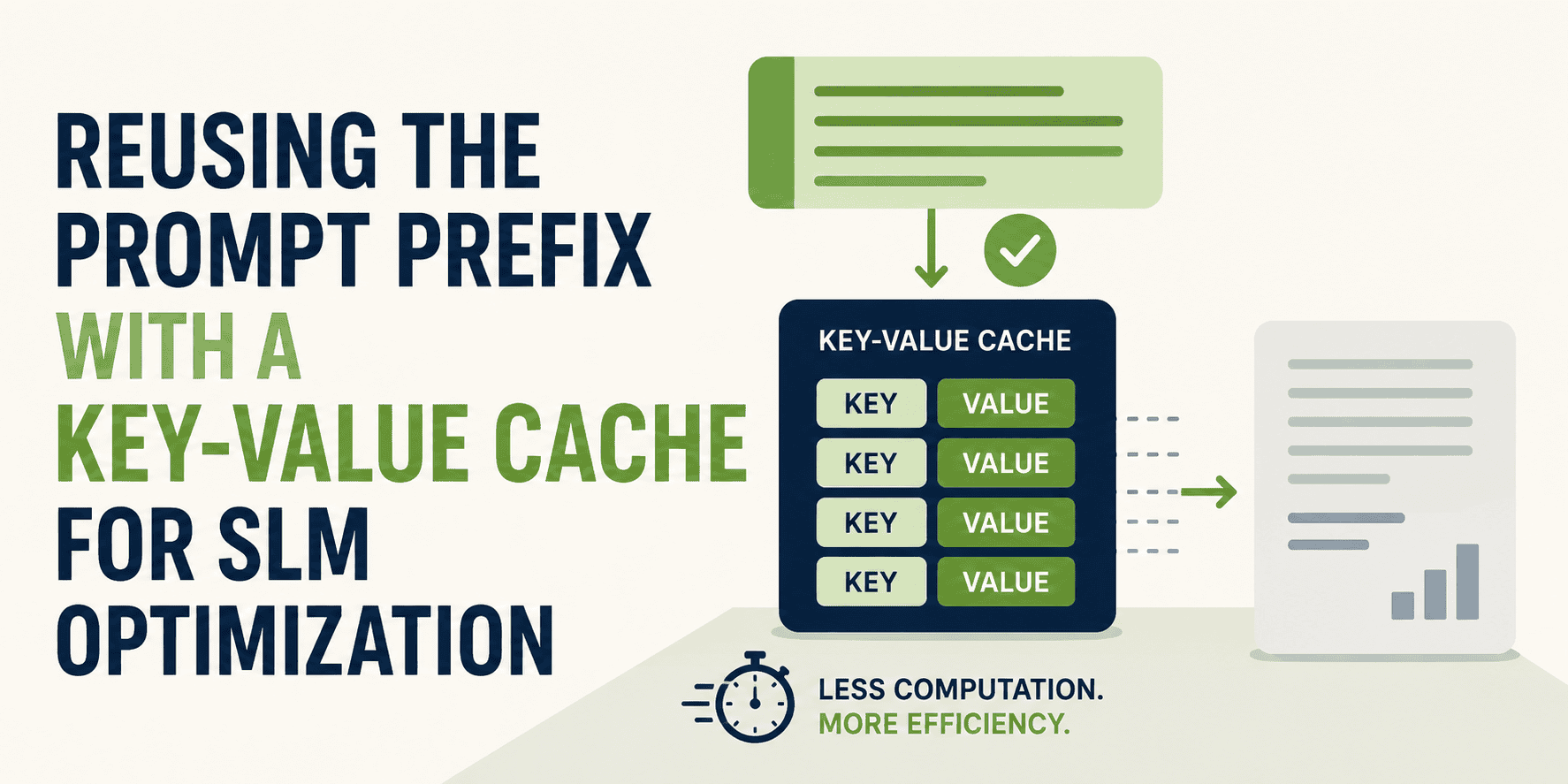
Now, let's combine these ideas to understand prompt prefix reuse. The core idea is simple: if a new prompt starts with a sequence of tokens that has been processed before, we can reuse the KV cache generated for that common prefix. We don't need to re-run the computationally intensive self-attention layers for those initial tokens.
Here’s a high-level breakdown of the process:
- Initial Prompt Processing: When an SLM processes a prompt for the first time (e.g., "Write a creative story about a magical forest and..."), it computes and stores the K and V vectors for each token in its KV cache.
- Prefix Identification: The system identifies and stores the KV cache associated with specific prompt prefixes. This might involve hashing the prefix or maintaining a lookup table.
- New Prompt Arrival: A new prompt arrives (e.g., "Write a creative story about a magical forest and a talking squirrel.").
- Prefix Matching: The system checks if the beginning of this new prompt matches any previously cached prefixes. In this example, "Write a creative story about a magical forest and" is a match.
- KV Cache Retrieval: If a match is found, the pre-computed K and V vectors for the matching prefix are retrieved directly from the cache.
- Incremental Computation: The SLM then only needs to compute the K and V vectors for the new part of the prompt (e.g., "a talking squirrel."). These new vectors are appended to the retrieved cached vectors.
- Continued Generation: With the combined KV cache, the model proceeds to generate the rest of the response efficiently.
This technique is particularly effective in scenarios like chatbots, where a conversation history often serves as a long prompt prefix for the next user query, or in applications generating variations of content based on a common template.
Why This Matters: Benefits of SLM Optimization
The reuse of prompt prefixes with a KV cache brings several significant advantages, especially for SLMs where efficiency is a key selling point:
- Reduced Latency: By avoiding redundant computations, the time it takes for the SLM to process a prompt and generate a response (inference latency) is significantly reduced. This means quicker interactions for users.
- Lower Computational Cost: Fewer computations translate directly to less GPU or CPU usage. For organizations deploying SLMs at scale, this can lead to substantial savings in operational costs.
- Improved Throughput: With faster processing per request, the SLM can handle more requests in a given period, increasing its overall throughput. This is crucial for high-demand applications.
- Enhanced Memory Efficiency (in context): While the KV cache itself consumes memory, reusing it prevents the repeated allocation and computation of K and V vectors for identical prefixes, leading to a net gain in overall system efficiency. It optimizes the use of computational memory over time.
Practical Implications for AI Practitioners
For anyone working with SLMs, understanding and implementing KV cache reuse can be a game-changer. Here's what it means in practice:
- Deployment Strategy: When designing SLM-powered applications, consider common prompt patterns. If users frequently ask similar questions or interact in structured ways, this optimization can be baked into your deployment strategy.
- Framework Support: Many modern AI frameworks and inference engines already support or are actively developing features for KV cache management. Libraries like Hugging Face Transformers, for instance, have sophisticated attention mechanisms and often manage the KV cache internally during generation. Specialized inference servers like vLLM are designed to maximize throughput by efficiently managing KV caches, including techniques that are implicitly related to reusing computations.
- Custom Implementation: For highly specialized use cases, practitioners might implement custom caching layers to manage and retrieve KV caches for specific prompt prefixes, perhaps using a database or a dedicated caching service.
- Session Management: In conversational AI, the KV cache can be maintained across turns for a specific user session, allowing the model to "remember" the context of the conversation more efficiently without re-processing the entire dialogue history each time.
While the concept is straightforward, effective implementation requires careful consideration of cache invalidation (when should a cached prefix be updated or removed?) and cache size management (how much memory are we willing to dedicate to storing these cached vectors?).
Conclusion
The reuse of prompt prefixes with a Key-Value cache is a powerful, yet elegant, optimization technique for Small Language Models. By intelligently storing and retrieving pre-computed attention states, it tackles the problem of redundant computations head-on. For AI practitioners, this means the ability to deploy SLMs that are not only faster and more responsive but also more cost-effective to operate. As SLMs continue to grow in popularity, techniques like KV cache reuse will be essential for pushing the boundaries of what these compact, powerful models can achieve.
Frequently Asked Questions
What is a Key-Value (KV) cache in the context of language models?
A Key-Value (KV) cache stores the "key" and "value" vectors computed during the self-attention mechanism of a transformer model for previously processed tokens. This prevents the model from re-computing these vectors for every past token at each step of text generation, significantly speeding up the inference process.
How does reusing prompt prefixes with a KV cache optimize SLMs?
It optimizes SLMs by identifying common beginnings (prefixes) in different prompts. When a new prompt shares a prefix with one already processed, the system retrieves the pre-computed KV cache for that prefix. The SLM then only computes the KV vectors for the new, unique part of the prompt, saving significant computational resources and reducing latency.
What are the main benefits of using this optimization technique?
The primary benefits include reduced inference latency, lower computational costs (less GPU/CPU usage), and improved throughput, meaning the SLM can handle more requests in a given time. This makes SLM deployments more efficient and cost-effective.
Is this optimization technique specific to SLMs, or can it be used with larger LLMs too?
While this technique is particularly beneficial for optimizing SLMs due to their focus on efficiency, the underlying principle of KV cache reuse is applicable and widely used in larger LLMs as well. It's a fundamental optimization for transformer-based models of all sizes, especially during the token generation (decoding) phase.